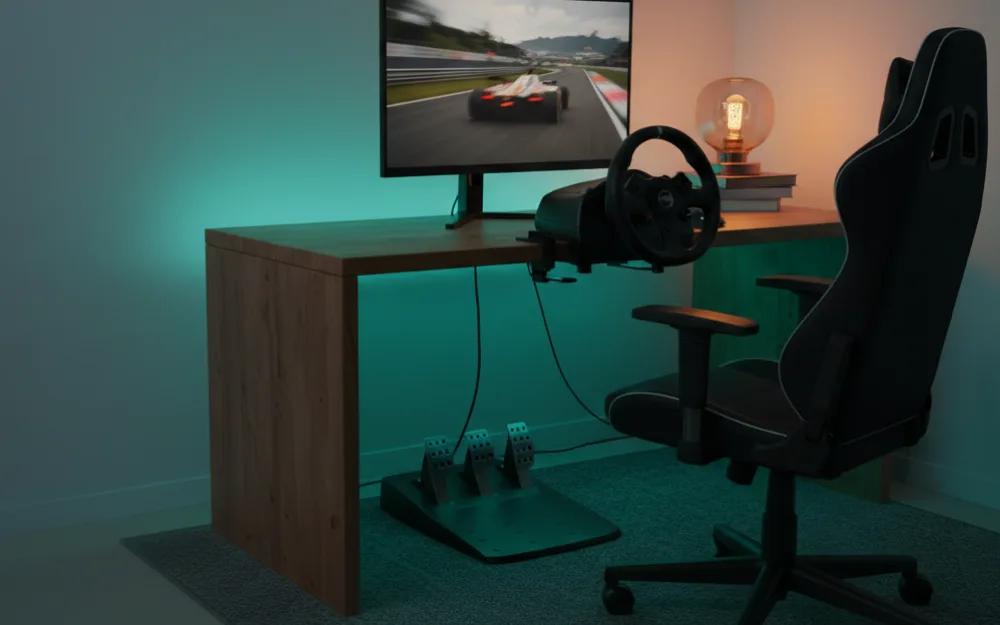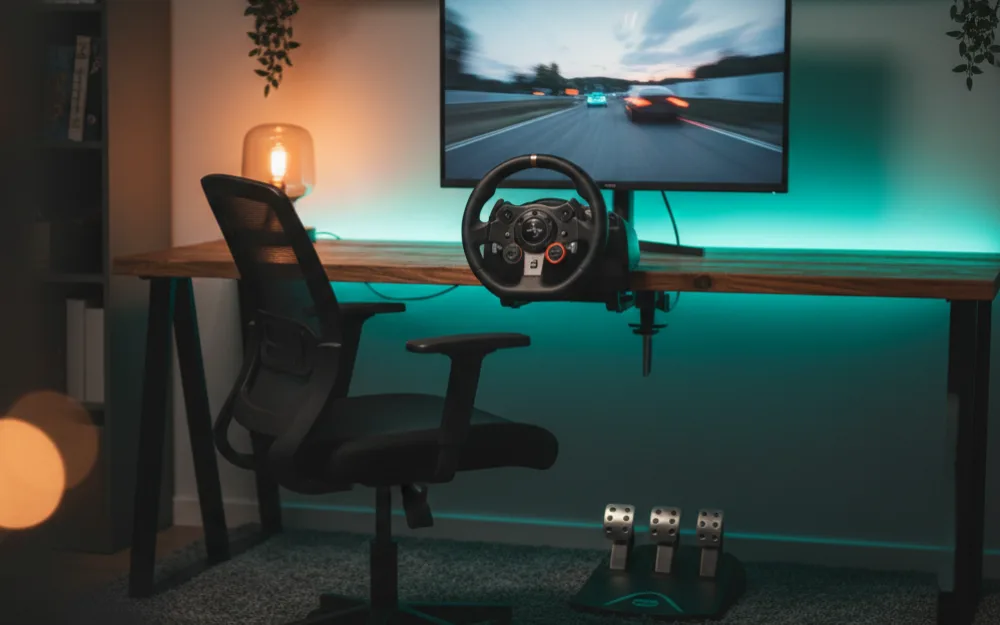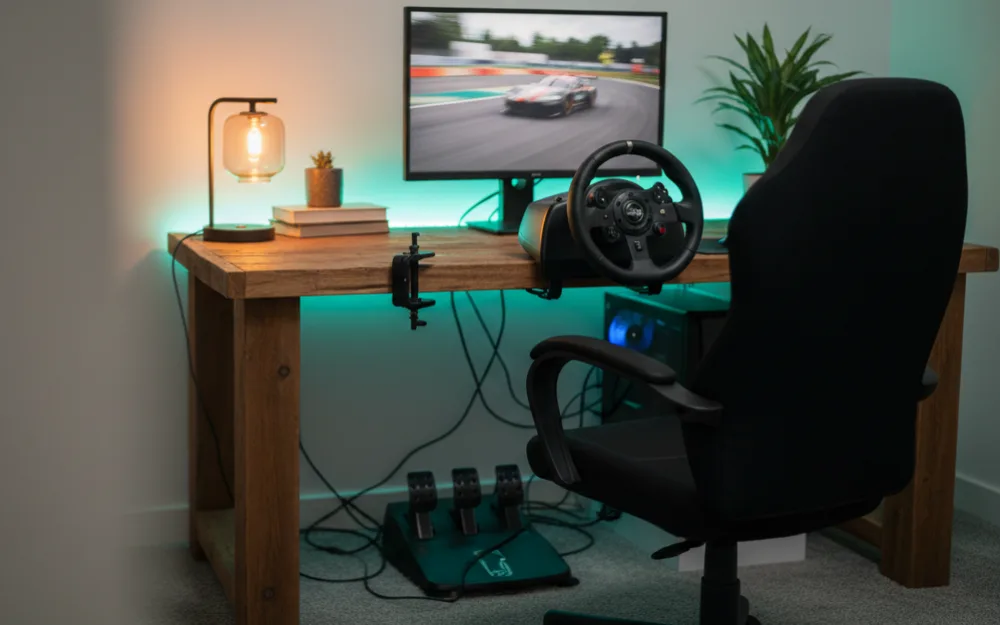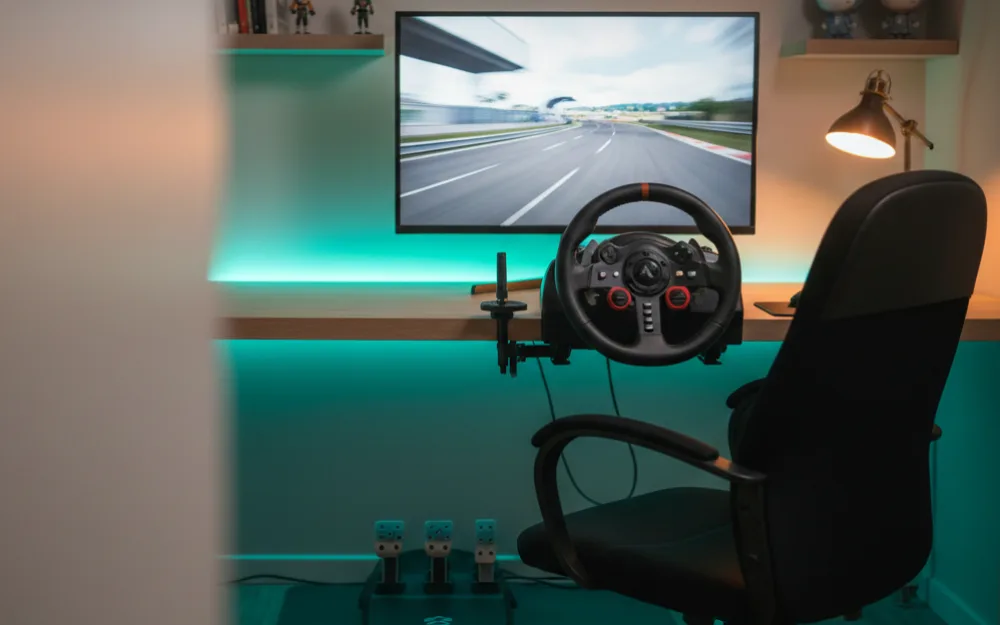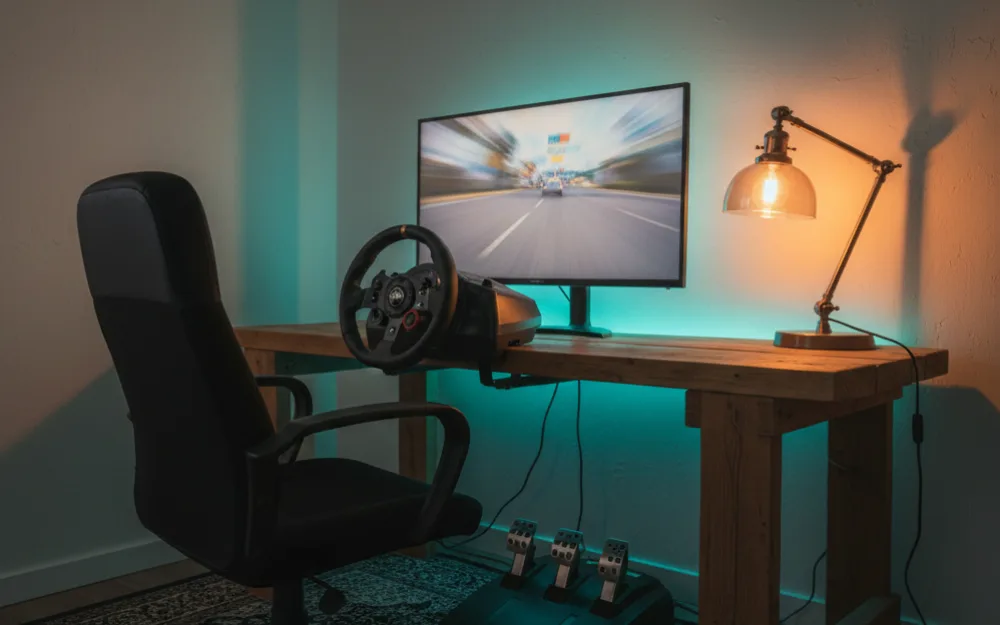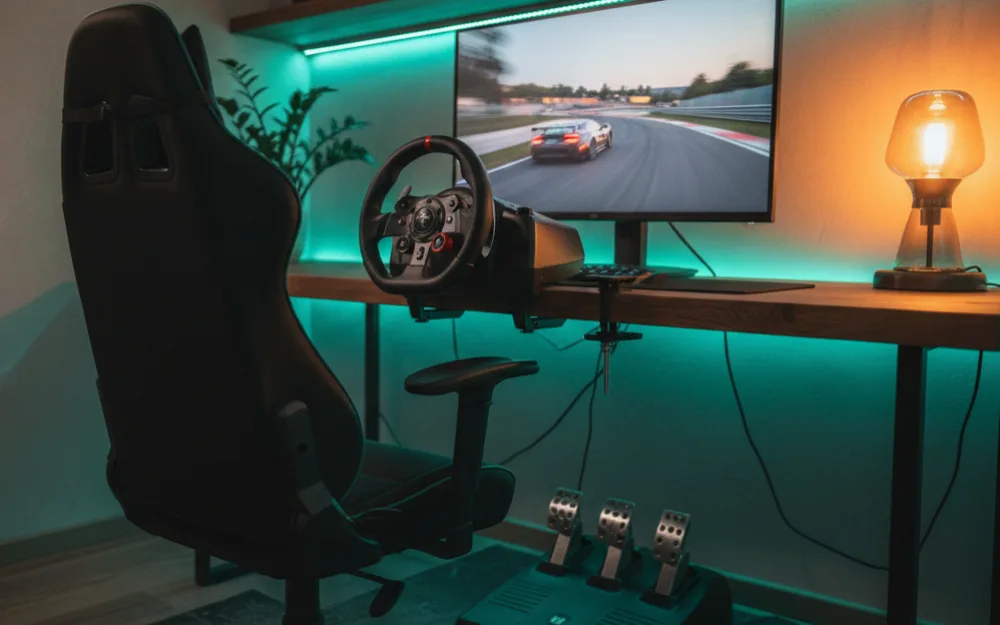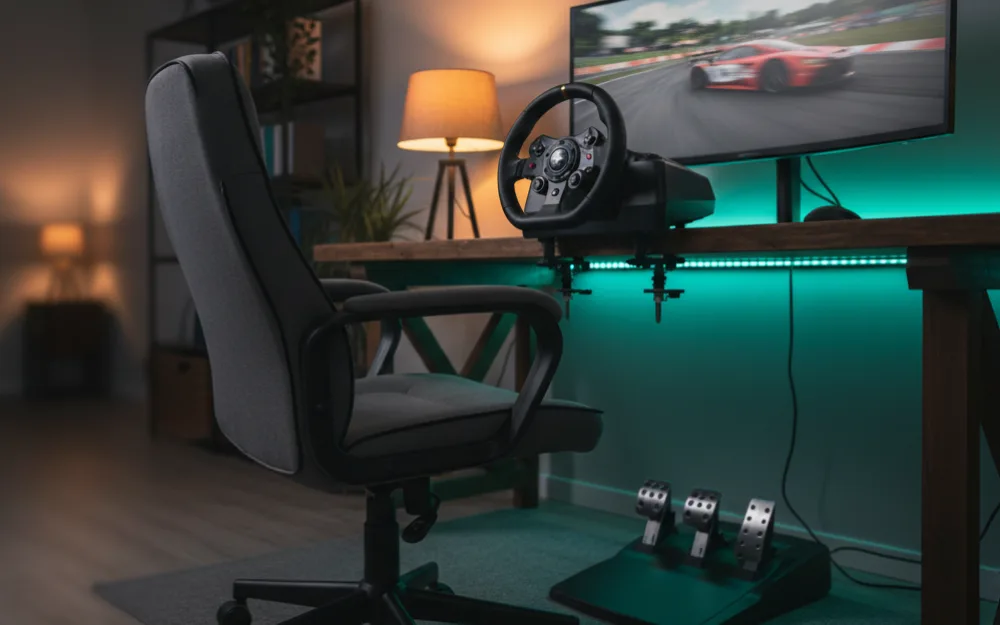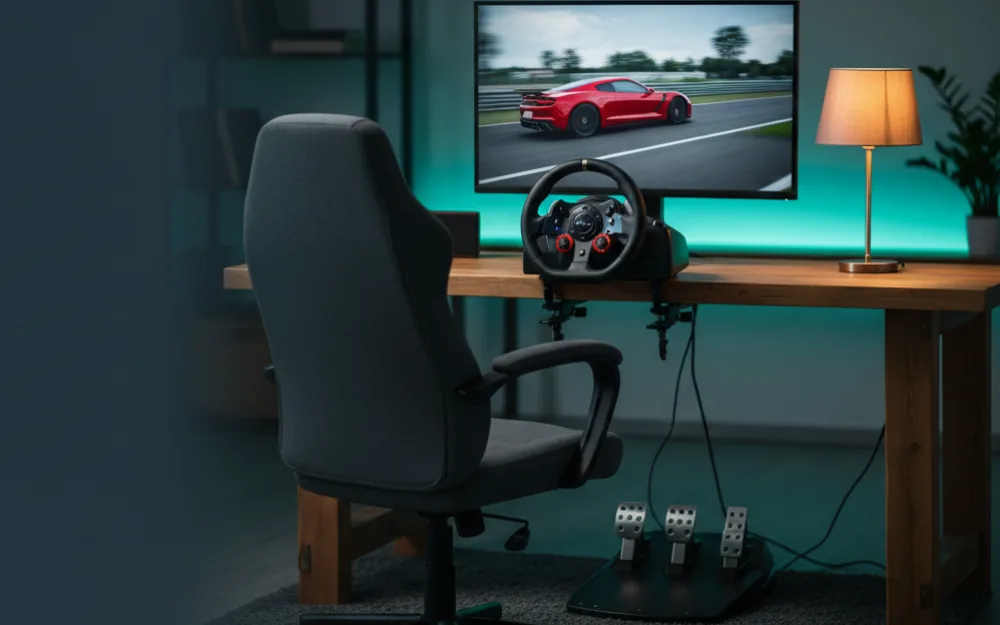


Ask experienced sim racers what upgrade improved their lap times most and the common answer is not a stronger wheel; it is a load cell brake. The reason is simple once you see how the sensors differ. This guide explains the three ways a pedal can measure your foot, why pressure beats travel for braking, and how to decide whether the upgrade is worth it for you.
Three ways to measure a pedal
Potentiometer
A potentiometer is a rotary resistor on the pedal pivot. As the pedal moves, resistance changes and the wheel reads that as position. It measures travel: how far the pedal has moved. It is cheap and simple, which is why bundled pedals on the Logitech G29, G920, and G923 use it. The downside is wear: the contact track abrades over time and the reading drifts or spikes.
Hall effect
A Hall effect sensor reads the position of a magnet without touching it. It still measures travel, but with no contact there is nothing to wear, so the reading stays accurate for years. Thrustmaster’s H.E.A.R.T pedals, Moza’s SR-P Lite, and the throttle on most load cell sets use Hall sensors.
Load cell
A load cell is a strain gauge that measures force. The brake pedal pushes against a stack of rubber elastomers or a spring, and the load cell reports how hard you are pressing rather than how far the pedal has moved. Capacity is quoted in kilograms: 75 kg on the Logitech RS Pedals, 100 kg on the PRO Pedals, Thrustmaster Raceline III LC, and Moza SR-P, and 200 kg on the Simjack UT. That number is the sensor’s range, not how hard you must press.
Why pressure beats travel for braking
Real brakes are hydraulic. Once the pads touch the disc the pedal barely moves; what changes is how hard you push. Your leg is far better at repeating a pressure than repeating a position, which is why drivers brake consistently in real cars without looking at their feet.
A travel based brake asks your leg to find the same position every lap, which it cannot do precisely, so braking varies from corner to corner. A load cell asks for the same pressure, which your leg remembers. The result is trail braking that is repeatable, fewer lock ups, and later braking with confidence. Throttle and clutch do not benefit as much, which is why most sets use a load cell only on the brake.
What the upgrade feels like
A load cell brake is stiff. The pedal moves an inch or so and then you are pushing against rubber. New owners often find it heavy for a week and then cannot go back. Most sets ship with elastomers in different hardnesses (Fanatec includes 65, 75, and 85 Shore in the CSL Elite V2) so you can tune the feel, and software lets you set full braking at whatever force suits you.
When it is worth it
| Situation | Recommendation |
|---|---|
| Casual play on a gear driven wheel | Not yet; upgrade the wheel first |
| Racing online weekly, any wheel | Yes, it is the highest value upgrade |
| Owner of an entry direct drive bundle with two pedals | Yes, and it usually adds a stiffer brake feel the bundle lacks |
| Pedals on a bare floor with no mount | Fix the mount first; a load cell brake pushes the pedals away harder than any other |
| Console with a Logitech G series wheel | Only with the Logitech Racing Adapter; check compatibility before buying |
Compatibility warning
On PC, load cell pedals connect over USB and work with any wheel. On PlayStation and Xbox, pedals must plug into the wheel base and are brand locked: Logitech pedals into Logitech bases, Fanatec into Fanatec, Thrustmaster into Thrustmaster, Moza into Moza. Asetek and Simjack sets are PC only. Our compatibility guide has the matrix and our pedal roundup compares the current sets.
Setting up a load cell brake
- Mount the pedals so they cannot move; a stand or cockpit is strongly recommended.
- Start with the softest elastomer or spring and increase stiffness once you are used to the feel.
- In the pedal software, set 100 percent brake at a force you can hold comfortably for a two hour race, not at the sensor’s maximum.
- Calibrate in the game as well, so the game sees the full range.
- Expect a few sessions of lock ups while your leg relearns; that is normal.
Frequently Asked Questions
Is a Hall effect pedal a load cell?
No. Hall effect measures position without wear; a load cell measures force. Many sets use Hall on throttle and clutch and a load cell on the brake.
Do I need 200 kg of capacity?
No. Capacity is the sensor’s range. Most drivers set full braking at a fraction of it; higher capacity mainly gives finer resolution across the range you use.
Can I add a load cell to my existing pedals?
Thrustmaster sells an upgrade kit for the Raceline Pedals III, and third party kits exist for some Logitech and Fanatec pedals. For most bundled pedals a new set is simpler.
Are hydraulic pedals better than load cell?
Hydraulic damping changes how the pedal feels during the stroke; the measurement is still usually a load cell. Sets like the Simjack UT combine both.
- September 2026: first published.