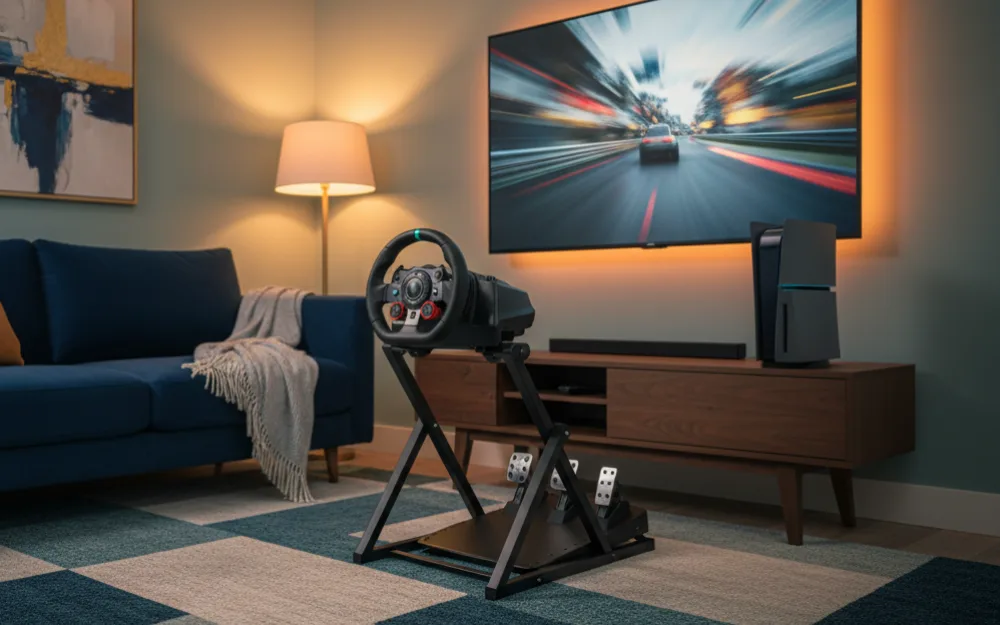



Gran Turismo 7 is the game that turns a PlayStation into a sim racing rig for a huge number of drivers, and it carries that role with the weight of more than 25 years of series history behind it. Hardcore simulation was never its aim, and it is stronger for the choice. What you get instead is a polished, welcoming path into driving that scales from a casual controller session to a serious wheel setup, and knowing where it sits between arcade and simulation is the key to whether it is for you.
This review looks at how GT7 drives, where it shines, and where a dedicated sim would serve you better. We compared editorial reviews with recurring player feedback rather than claiming a seat time we do not have, and you can read how we review. If the genre is new to you, our Getting Started hub covers the basics.
At a glance
| Aspect | Gran Turismo 7 |
|---|---|
| Platforms | PlayStation 5, PlayStation 4 |
| Driving model | Simcade, between arcade and simulation |
| Wheel support | Yes, PlayStation compatible wheels |
| Focus | Broad career, car collection, online Sport mode |
| Notable requirement | Online connection for much of the game |
Where GT7 sits in the landscape
To judge GT7 fairly, you have to place it. It is a simcade, which means it lands between an arcade racer that prizes fun and a full simulator that prizes realism. Reviewers describe handling that is approachable on a controller yet detailed enough to reward a wheel, closer to simulation than most console racers but softer than a dedicated PC sim like Assetto Corsa Competizione. That middle ground is the whole point: it is built to be the widest possible on-ramp.
How it drives
Reviewers who race GT7 on a wheel consistently describe forces that communicate the important cues clearly: weight transfer through a corner, the front tires beginning to slide, the point where grip returns on exit. Players note that the physics reward smoothness and reward learning a car rather than brute inputs, while remaining forgiving enough that a newcomer with a controller is not immediately lost. Critics are also clear about the ceiling: the fine detail and edge-of-grip nuance fall short of what committed simulators deliver, which is a fair trade for its accessibility.
Content, career, and presentation
This is where GT7 flexes. The car list is enormous, spanning road cars, classics, and race machinery, and reviewers praise the reverence the game shows for automotive history through its collection and museum-style features. The career eases you in with license challenges and events, and the online Sport mode gives competitive players a structured place to race. Presentation earns wide credit too: sharp visuals, strong audio, and thoughtful use of the PS5 hardware.
The friction points
No honest review skips the complaints, and GT7 has two recurring ones. The first is the always-online requirement for much of the single-player game, which players criticize because it makes your library dependent on server status. The second is the in-game economy, which some drivers find slow and weighted toward grinding or spending. Neither ruins the driving, but both are real friction that a buyer should weigh.
Who should buy it, and who should skip it
| Buy GT7 if | Skip it if |
|---|---|
| You race on PlayStation and want a broad, polished career | You want the sharpest, most demanding simulation available |
| You value a huge car list and car culture | You dislike always-online requirements |
| You want a game that works with a controller or a wheel | You are on PC and want modding and open lobbies |
Alternatives and next steps
If you want to see how GT7 stacks up against the rest of the console field, start with our best racing games for PS5 roundup. For a look at the more structured, simulation-heavy end of the hobby, our iRacing review shows what a subscription sim asks and gives in return. You can also browse more titles in the Console Racing Games category, and if you are ready to add a wheel, our best sim racing wheels guide is the place to begin.