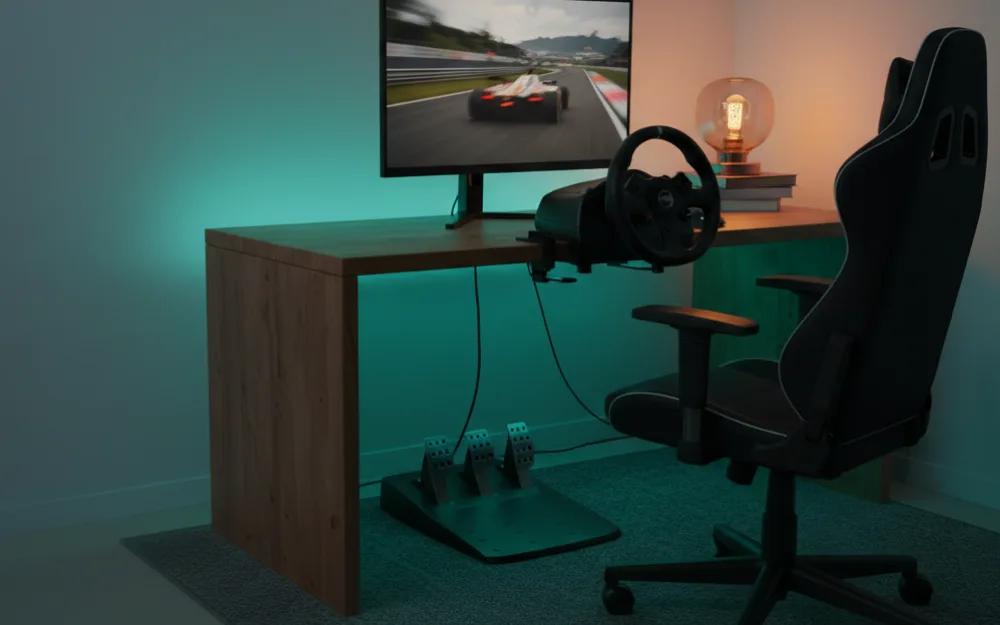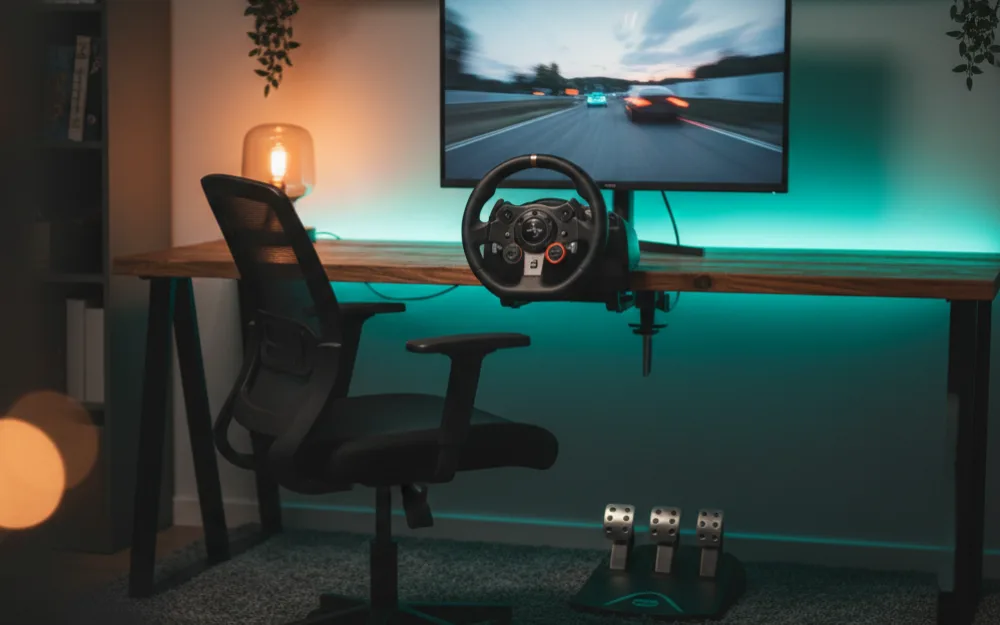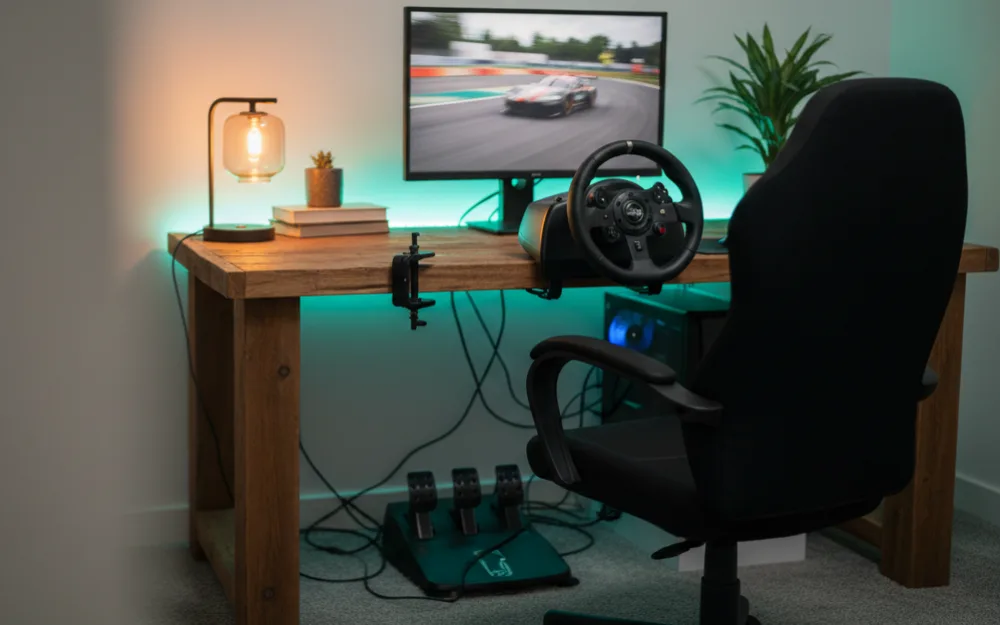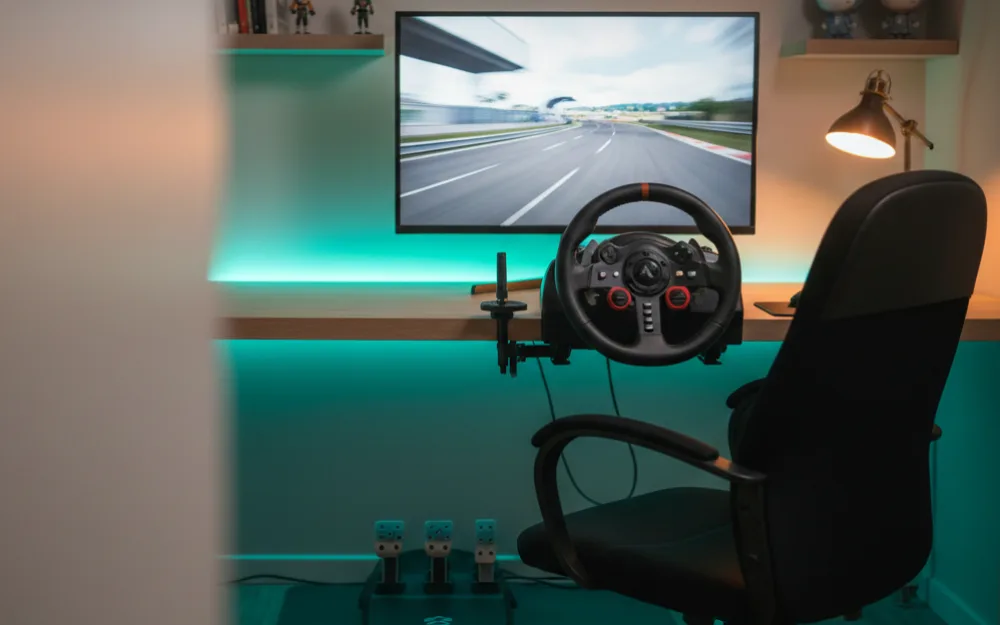

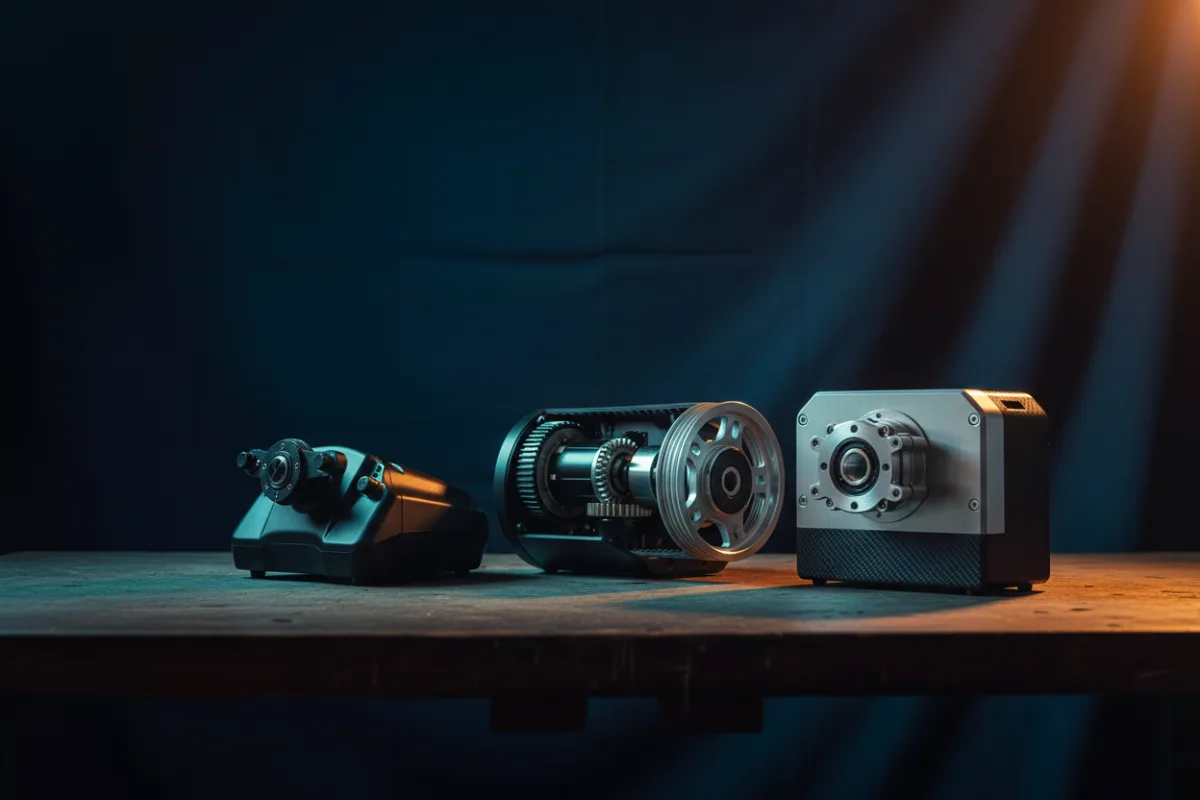

Every force feedback wheel has a motor, and the difference between a cheap wheel and an expensive one is mostly how that motor connects to the rim in your hands. There are three answers: through a gearbox, through a belt, or directly. This guide explains each mechanism, what it feels like, where the torque numbers come from, and which one is the right buy for your platform and budget.
Gear driven
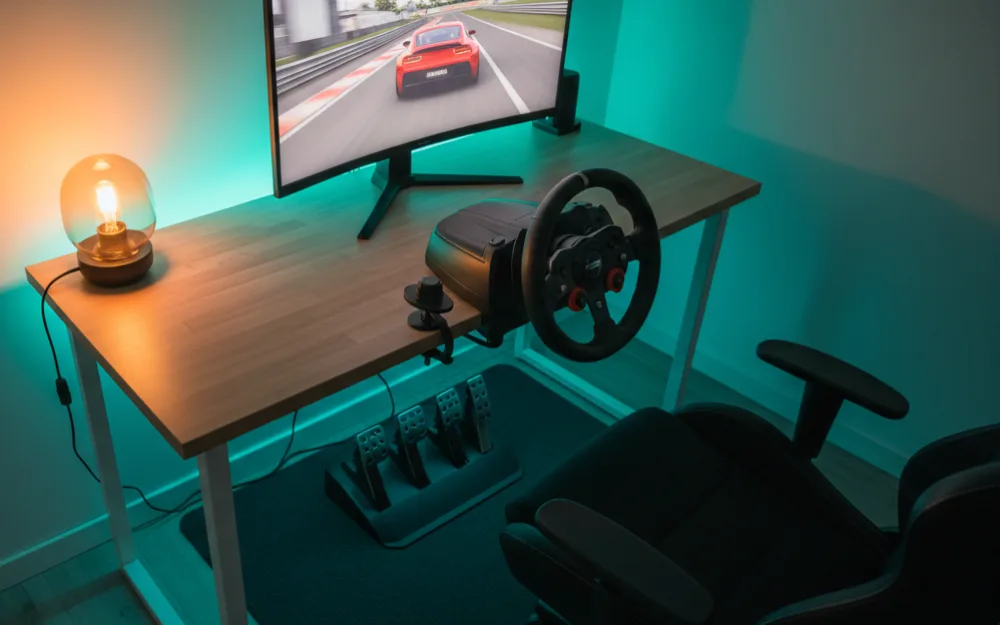
A gear driven wheel uses one or two small motors turning a set of plastic or metal gears that spin the wheel shaft. Logitech’s G29, G920, and G923 are the reference examples and have been for a decade. Gears are inexpensive, compact, and durable, which is why these wheels dominate the entry market.
What you feel is the gears. Small effects arrive with a slight rattle or notchiness, and there is a little play at center. Logitech’s TRUEFORCE on the G923 adds high frequency vibration effects from supported games that mask some of this. Logitech does not publish a torque figure for these wheels.
- Strengths: lowest price, three pedals in the box, universal game support, strong resale.
- Weaknesses: coarse feel, fixed rim, no upgrade path beyond a shifter.
Belt driven and hybrid
A belt driven wheel uses a toothed belt between the motor and the shaft, which smooths out the mechanical noise of gears. Thrustmaster’s T300 RS GT and TX use dual belt systems; the T128 and T248 use what Thrustmaster calls hybrid drive, combining a belt with gears. Thrustmaster publishes 3.1 Nm for the T248 and does not publish figures for the T300 or T128.
Belt wheels feel smoother and quieter than gear wheels, with less rattle over curbs. The belt itself absorbs some fine detail, so very small effects can feel slightly soft, and belts can stretch or slip over years of use. Many belt wheels have detachable rims, which is the start of an ecosystem.
- Strengths: smoother than gears, often a detachable rim, moderate price.
- Weaknesses: now priced close to entry direct drive, which is better; softened fine detail.
Direct drive
A direct drive wheel has no gears and no belt. The rim mounts to the motor shaft, usually through a quick release, and the motor is a servo motor with a high resolution encoder. Every effect the game sends arrives at your hands without anything in between. Moza, Fanatec, Simagic, Logitech (RS50 and PRO), and Thrustmaster (T598 and T818) all sell direct drive bases, from 3.9 Nm entry units to 20 Nm and beyond.
What you feel is the tire. Weight transfer, the moment grip starts to go, the texture of a curb, all arrive immediately and precisely. Because the motor is strong, direct drive also needs a solid mount; it will move a light desk, and it can hurt if you fight a high torque base incorrectly. Direct drive bases run quietly, though some, such as the Moza R9 V3, use active cooling.
- Strengths: the best feedback available, quick release rims, long upgrade paths, quiet.
- Weaknesses: needs a rigid mount, entry bundles ship with two pedals, console licensing is limited to specific models.
Side by side
| Drive type | How it works | Feel | Typical torque (published examples) | Mounting | Examples |
|---|---|---|---|---|---|
| Gear driven | Motor turns gears that turn the shaft | Notchy, some center play, durable | Not published by Logitech | Any desk | Logitech G29, G920, G923 |
| Belt and hybrid | Motor turns a belt (sometimes with gears) that turns the shaft | Smooth, slightly softened detail | 3.1 Nm (Thrustmaster T248); others not published | Any desk | Thrustmaster T128, T248, T300 RS GT, TX |
| Direct drive | Rim mounts to the motor shaft | Immediate, detailed, strong | 3.9 Nm (Moza R3) to 12 Nm (Moza R12) and above | Solid desk up to about 5 Nm; stand or cockpit above | Moza R3/R5/R9/R12, Fanatec CSL DD, GT DD Pro, Logitech RS50, PRO, Thrustmaster T598, T818 |
What torque numbers mean
Torque in newton meters (Nm) is the rotational force the motor can apply to the rim. Manufacturers quote it as peak, maximum, or constant, and those are not the same thing: a peak figure is a short burst, a constant figure is sustained. Compare like with like, and read our torque guide for how much you actually need. Gear and belt makers often do not publish a figure at all, which itself tells you something about the category.
Which one should you buy
If the budget reaches an entry direct drive bundle and you have a solid desk or stand, buy direct drive. It is the purchase you will not replace, and the ecosystem lets you add rims, pedals, and shifters later. Our direct drive guide compares the current options.
If the budget does not reach it, a gear driven Logitech is the safe choice for its game support, three pedals, and resale value, and a Thrustmaster hybrid is the smoother alternative. Both are covered in our under $300 guide. Belt driven wheels at the price of entry direct drive are the hardest to recommend today unless you specifically want their rim ecosystem.
Frequently Asked Questions
Is direct drive dangerous?
Entry bases at 5 Nm are not. Higher torque bases can move fast enough to hurt a thumb hooked inside the rim, so drive with thumbs outside and start with strength turned down.
Is a belt wheel better than a gear wheel?
Smoother, yes. Whether it is better depends on whether you value smoothness over Logitech’s game integration and three pedals at a similar price.
Does direct drive work on PS5 and Xbox?
Yes, but only licensed models: Fanatec GT DD Pro, Logitech RS50 and PRO, and Thrustmaster T598 on PlayStation; Moza R3 Bundle, Logitech RS50 and PRO Xbox versions, and Fanatec bases with an Xbox wheel on Xbox.
- September 2026: first published.