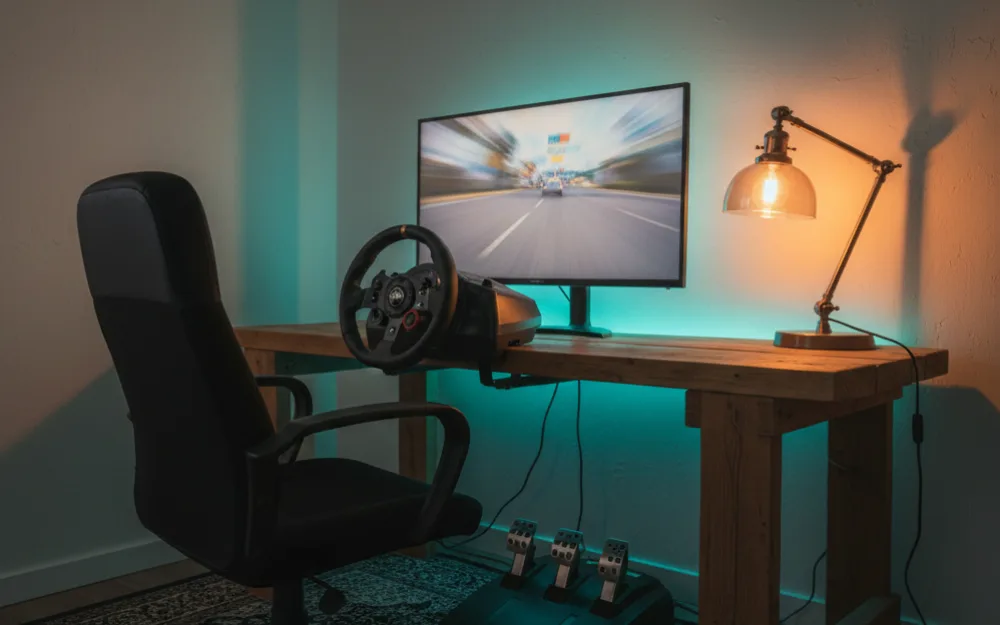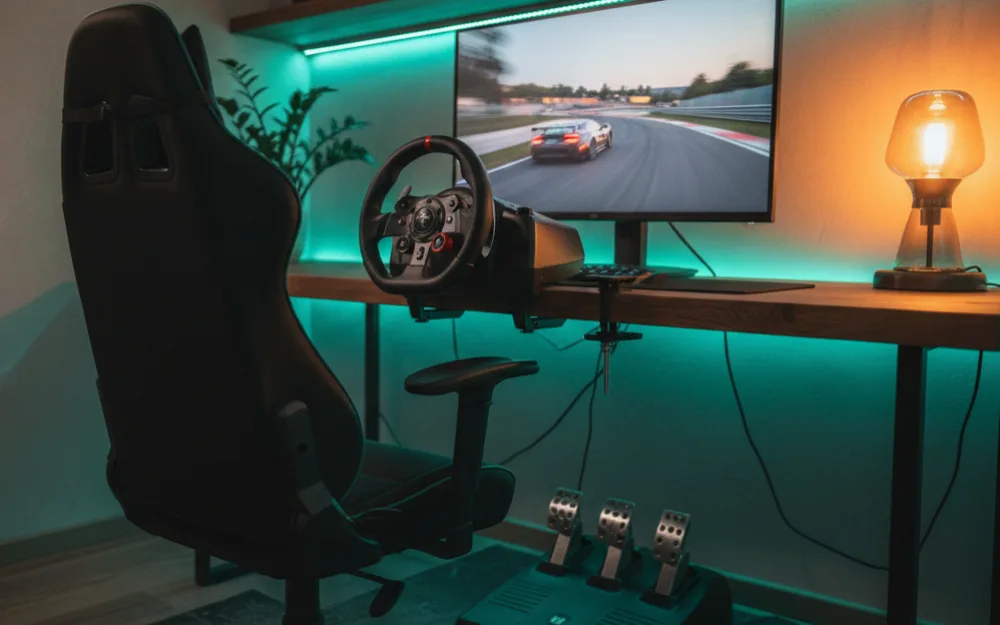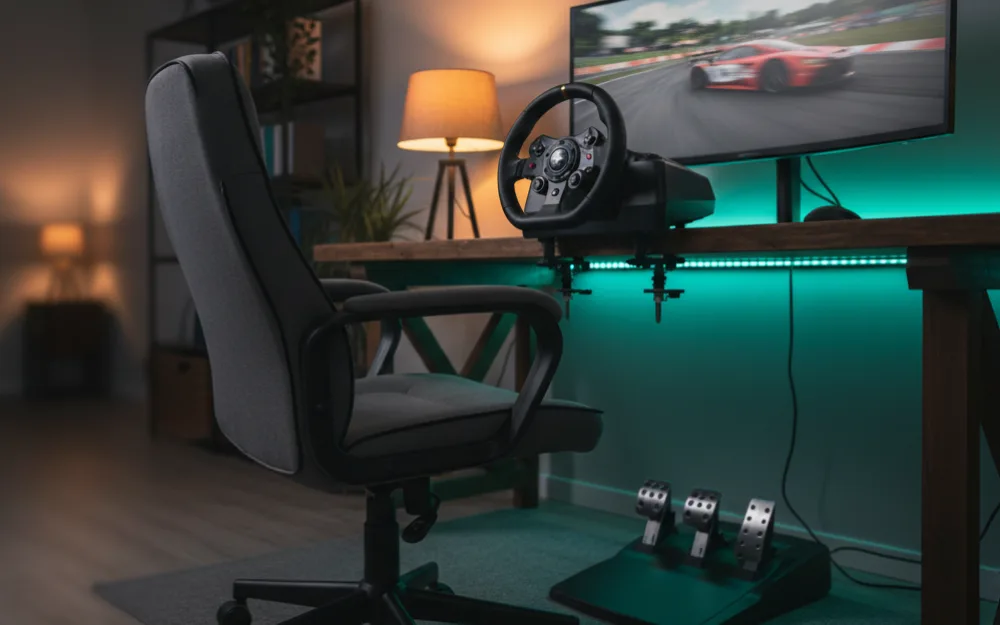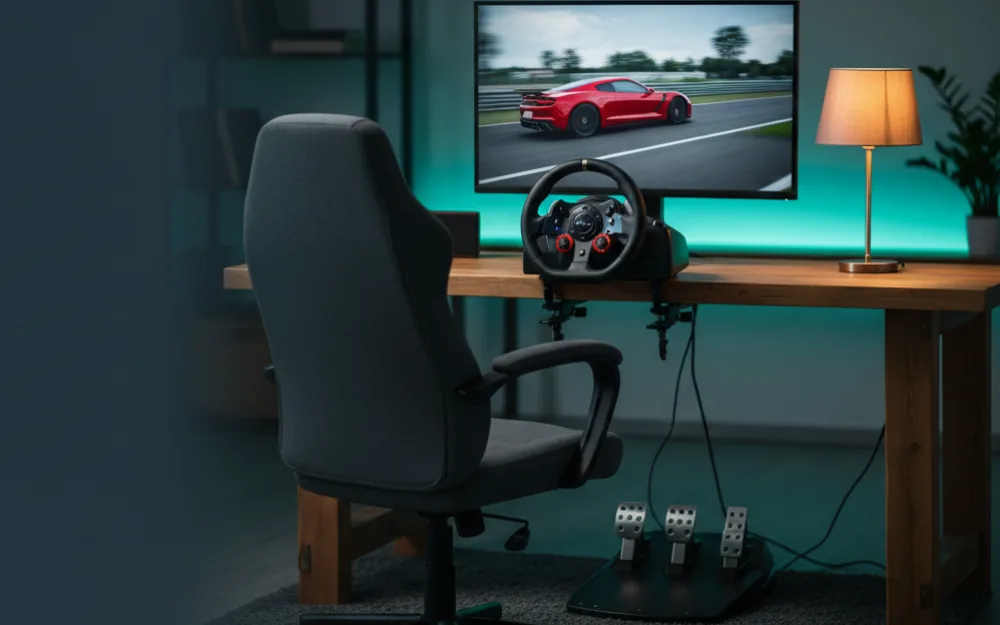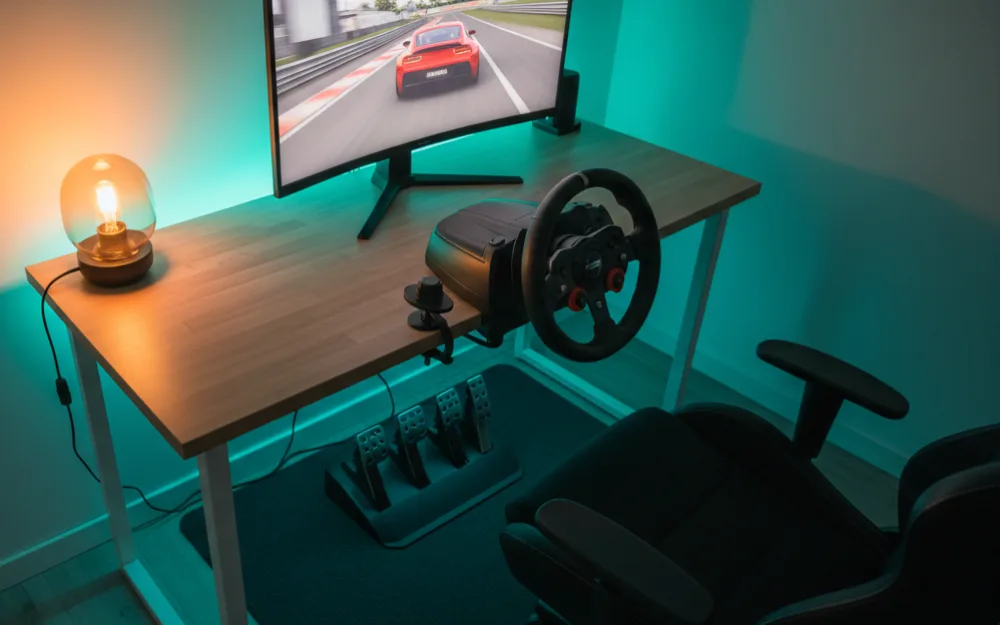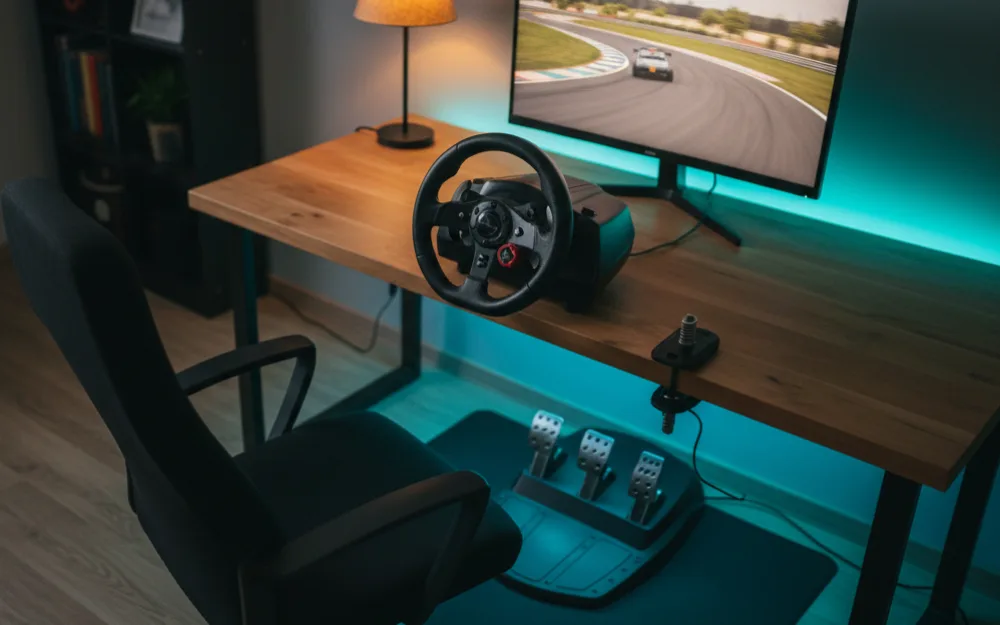

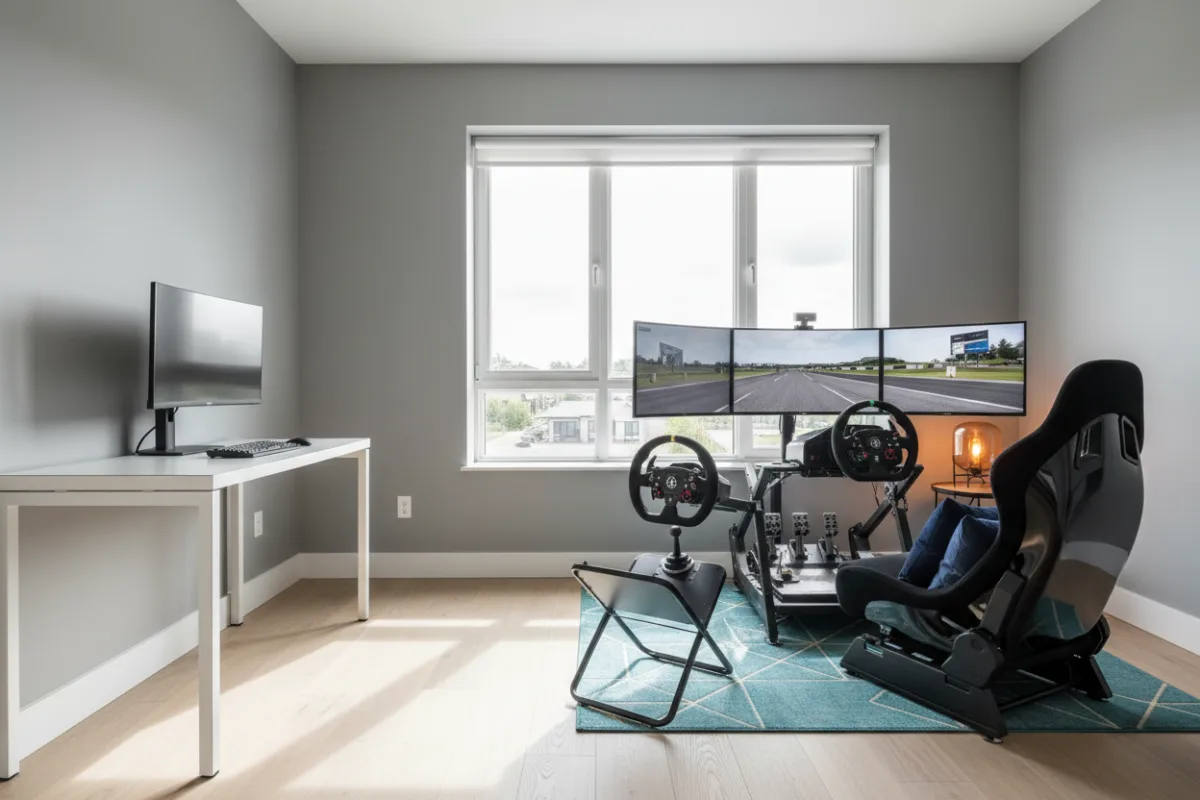

Where you mount the wheel decides how much of its feedback reaches your hands, how much room the hobby takes, and how much you spend. There are three answers: the desk you already own, a wheel stand that holds wheel and pedals in front of any chair, or a cockpit with its own seat. This guide compares them on the things that matter and gives simple rules for choosing.
The three options
Desk mount
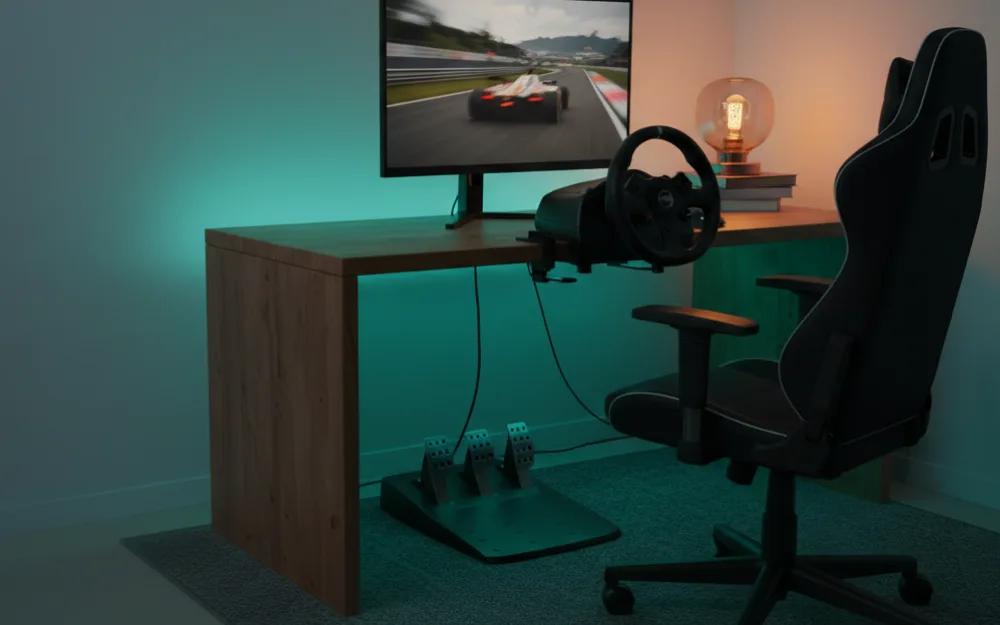
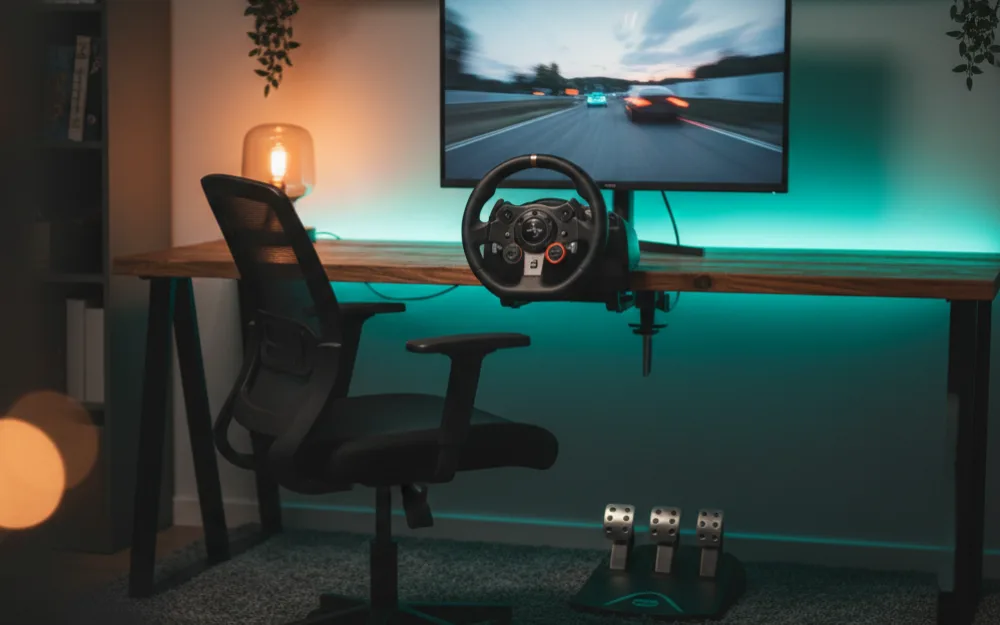
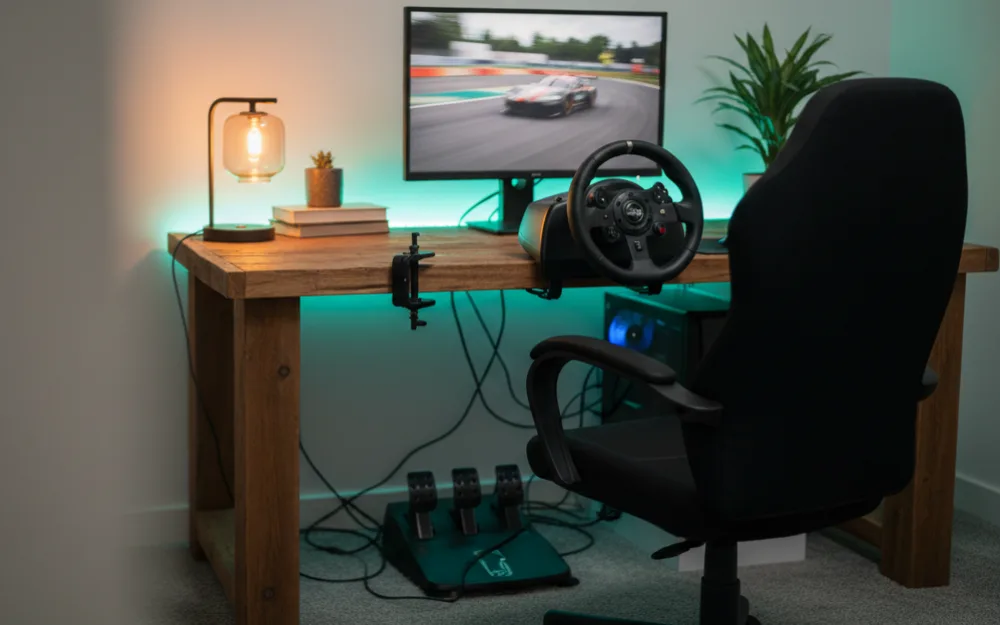
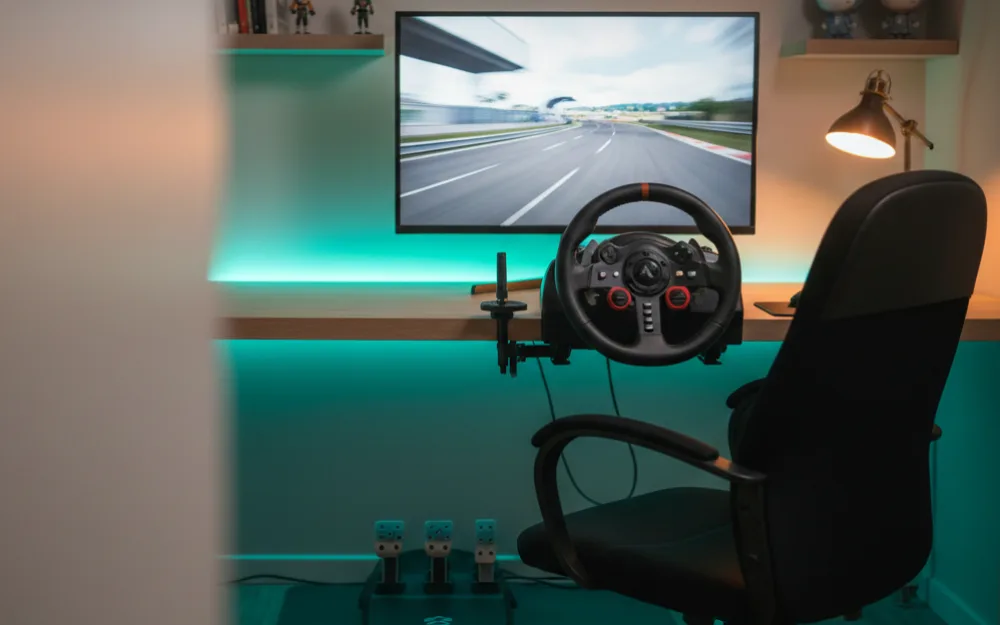
The wheel clamps to the front edge of a desk and the pedals sit on the floor. It costs nothing extra, takes no additional space, and works for gear and belt driven wheels and entry direct drive up to about 5 Nm on a heavy desk. The weaknesses are pedal slide, chair roll, and flex once torque rises. Our desk mounting guide covers how to get the most from it.
Wheel stand
A steel frame that holds the wheel deck and pedal plate at adjustable heights and angles, used with a chair you already own. Most fold flat for storage. Stands fix pedal slide and let you position the wheel correctly, and a few publish torque ratings: GT Omega’s DD-X to 21 Nm, Next Level Racing’s Wheel Stand Lite 2.0 to 10 Nm. The chair remains the weak point unless the stand includes a cradle or bar to hold it. See our wheel stand roundup.
Cockpit
A frame with an integrated seat, so driver, wheel, and pedals are one rigid unit. Tube frame cockpits arrive largely assembled and some fold (Next Level Racing GT Lite, Playseat Challenge); aluminum profile rigs are stiffer, heavier, and endlessly adjustable. Cockpits are the only correct answer for high torque bases and load cell pedals, and the only option that fixes chair roll completely. See our cockpit roundup.
Side by side
| Desk mount | Wheel stand | Cockpit | |
|---|---|---|---|
| Extra cost | None | Low | Moderate to high |
| Suitable torque | Up to about 5 Nm | Up to the stand’s rating (10 to 21 Nm on rated models) | Any, depending on frame |
| Rigidity | Depends entirely on the desk | Good; folding joints are the limit | Best |
| Footprint in use | None extra | About the size of a chair mat | Roughly 4 to 5 feet long by 2 feet wide |
| Storage | Unclamp the wheel | Most fold flat | Only foldable models |
| Pedal slide | A constant problem | Solved | Solved |
| Chair roll | A problem | Solved on stands with a cradle or bar | Solved |
| Driving position | Compromised by desk height | Adjustable, limited by the chair | Correct GT or formula position |
| Load cell pedals | Poor | Good | Best |
| Shifter and handbrake | Clamp to desk edge | Included plate on most | Included support on most |
Rules for choosing
- Gear or belt driven wheel, casual play: desk. Buy a stand only if pedal slide or chair roll annoys you.
- Entry direct drive (up to 5 Nm), shared room: rated folding stand. Add a seat later if the stand supports one.
- Entry direct drive, dedicated space: foldable or fixed tube frame cockpit.
- 8 to 12 Nm: cockpit with a stated rating (for example the GTRacer 2.0 at 13 Nm), or the GT Omega DD-X if a stand is the only option.
- Above 12 Nm, or triples, or motion: aluminum profile cockpit.
- Load cell pedals, any base: stand at minimum, cockpit preferred.
Space planning
Measure before ordering. A folding stand needs a spot the size of a chair mat in use and a slot about the size of a folded ironing board when stored. A GT cockpit is around four to five feet long, and a monitor stand in front adds a foot or more. A formula position cockpit is lower but not shorter. Check the listing dimensions, and remember that a cockpit against a wall needs clearance behind the seat for the recline.
The upgrade path
Some stands convert to cockpits with a seat add-on (Next Level Racing Wheel Stand 2.0 and Lite 2.0, GT Omega DD-X), which lets you spend in two steps without replacing the frame. A foldable cockpit is a dead end if you later move to high torque; a fixed tube frame with a stated rating or an aluminum profile rig carries you through several base upgrades.
Frequently Asked Questions
Is a wheel stand stable enough for direct drive?
Rated stands are. The GT Omega DD-X is rated to 21 Nm and the NLR Wheel Stand Lite 2.0 to 10 Nm; unrated budget stands are best kept to entry wheels.
Can I use my office chair with a stand?
Yes, but lock or replace the casters, and prefer a stand with a chair cradle.
Do foldable cockpits flex?
More than fixed ones; the folding joints are the weak point. They are fine for entry wheels and modest direct drive, less so above 8 Nm.
Tube frame or aluminum profile?
Tube frame for faster assembly, lower weight, and a seat in the box; aluminum profile for maximum stiffness, adjustability, and high torque.
- September 2026: first published.