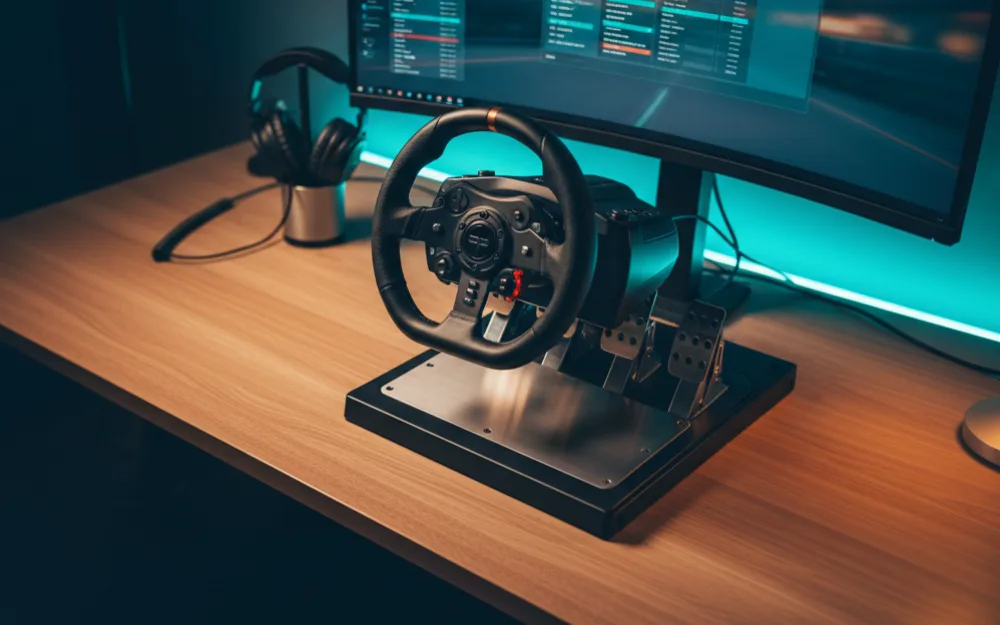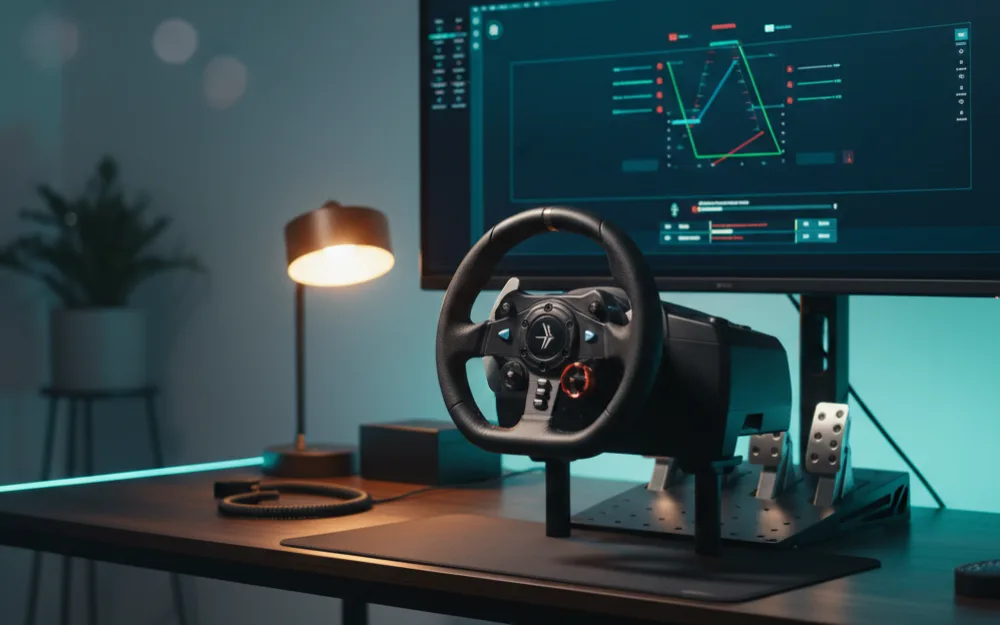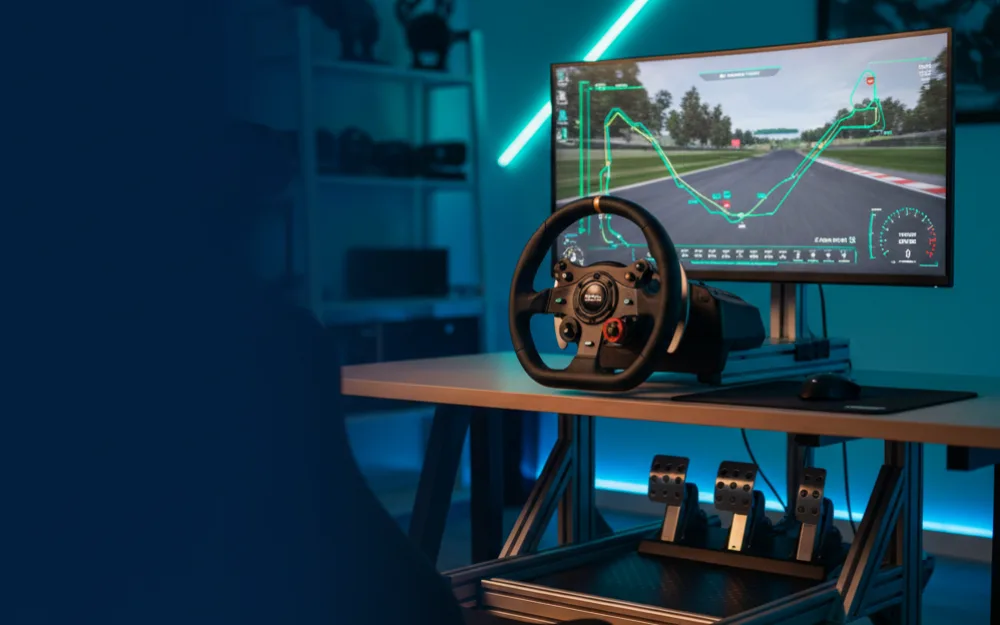


Most sim racers start on a desk, and most of the early frustration comes from a clamp that slips, a desk that flexes, or pedals that scoot across the floor at the first hard braking zone. This guide covers how to mount a wheel to a desk properly, what desk it needs to be, how to fix the pedals, and the point at which a desk stops being the right answer.
What the desk needs to be
Thickness
Every clamp has a range. Thrustmaster lists up to 2.2 inches for the T128, and other makers publish their own range in the manual. A desk edge thicker than the clamp opening needs a mounting plate instead. Very thin desks (under about 0.75 inch) flex and let the clamp rock; add a plywood pad under the clamp jaw.
Edge and depth
The clamp needs a clean, square front edge with at least 3 to 4 inches of clear underside; a desk with a front apron, a drawer, or a lip will not take a clamp. Depth matters for the pedals: your knees must clear the desk while your feet reach the pedals, which usually means 24 inches of depth or more and a chair that goes low enough.
Weight and rigidity
A gear or belt driven wheel is fine on almost any desk. An entry direct drive base around 5 Nm wants a heavy desk, ideally against a wall. Above 8 Nm a desk will walk, flex, and tip; that is stand and cockpit territory. See our torque guide for the reasoning.
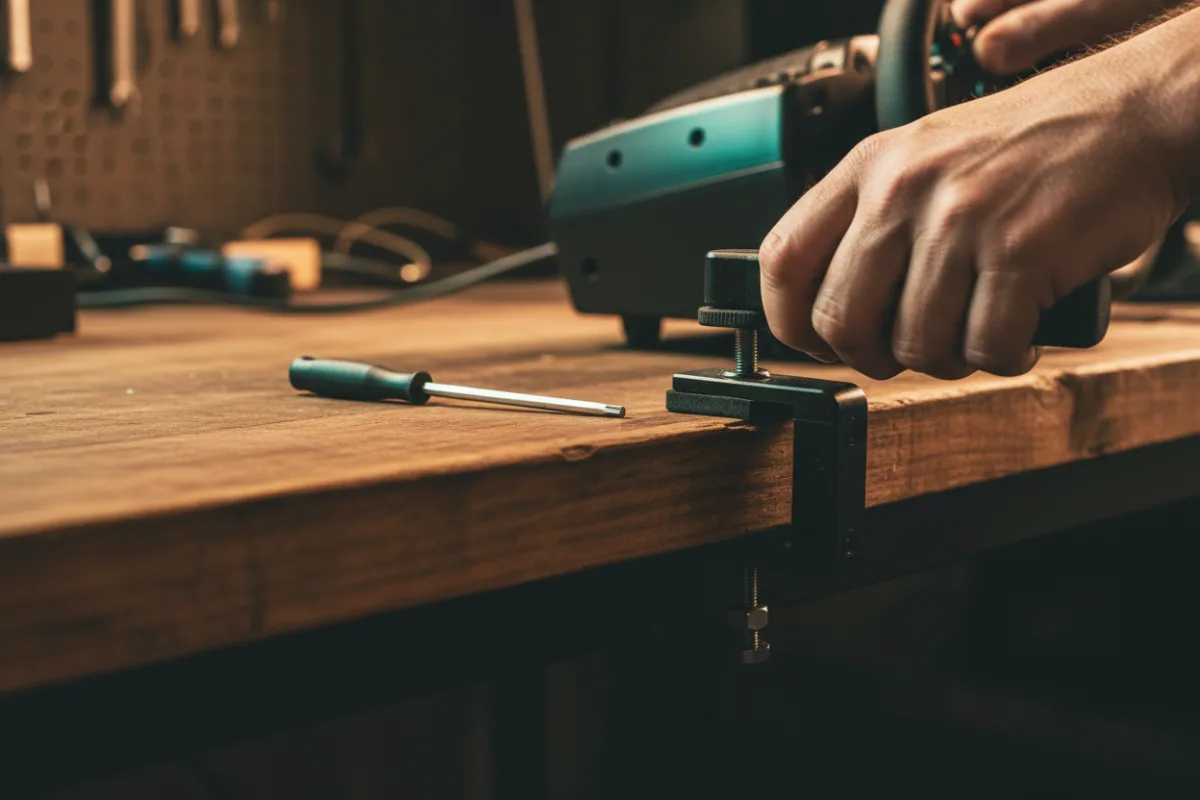
Mounting with the clamp
- Clear the edge of the desk and wipe it. Dust under the clamp is the usual reason it creeps.
- Position the wheel centered on your seat, close enough that your elbows stay bent with hands at nine and three. Most drivers sit closer than they expect.
- Tighten the clamp by hand until firm, then a quarter turn more. Over tightening cracks plastic clamps and dents wood.
- Grab the rim and rock it. If the base moves relative to the desk, add a rubber pad (a piece of yoga mat works) between the clamp and the desk and re-tighten. If the whole desk moves, the desk is the problem.
- Route the cables so the pedal cable is not pulled taut when you brake; strain on the connector is a common failure.
Mounting with a plate
Logitech, Thrustmaster, Moza, and Fanatec bases all have threaded holes underneath for hard mounting. A desk plate (sold by wheel makers and third parties) bolts to the base and clamps or screws to the desk over a wider area than the stock clamp, which stops rocking on thin desks and allows an angle adjustment. For a desk you own and are willing to drill, bolting the base through the desktop with T-nuts is the most rigid desk mount there is.
Stopping the pedals from sliding
Bundled pedals slide because the brake pushes back and the feet are small. Options, from cheapest to most solid:
- Push the pedals against a wall or the desk’s back panel so braking force has somewhere to go.
- Use the carpet spikes or grippers most pedal sets include; Logitech’s RS Pedals add an extendable brace that wedges against a wall.
- Put a rubber mat under the pedals and, on hard floors, a heavy object behind them.
- Screw the pedals to a plywood board and put the board under the front legs of your chair so your own weight holds it.
- Buy a wheel stand, which fixes pedals and wheel to one frame. This is the real answer for load cell pedals.
The chair
An office chair on casters rolls backward under braking. Lock the casters, replace them with glides, or use a chair without wheels. Set the seat low enough that your thigh is roughly level and your heel rests on the floor in front of the pedals.
When to stop using a desk
Move to a stand or cockpit when any of these is true: the base is 8 Nm or more, you have bought load cell pedals, the desk moves when you brake, or you keep the setup permanently anyway. Our cockpit versus stand versus desk guide and our wheel stand roundup cover the next step.
Frequently Asked Questions
Can I mount a direct drive wheel to a desk?
Up to about 5 Nm on a heavy desk, yes. Most entry direct drive bundles include a desk clamp for this reason. Above that, a stand or cockpit.
Will the clamp damage my desk?
It can dent soft wood or veneer. A rubber pad under the clamp jaw prevents it and improves grip.
My desk has a keyboard tray. Can I still clamp?
Only if you can remove the tray rails from the front edge. Otherwise a stand is the practical option.
Is a standing desk stable enough?
Rarely for direct drive. Motorized legs flex and the desk rocks; they are fine for gear driven wheels at the lowest height.
- September 2026: first published.