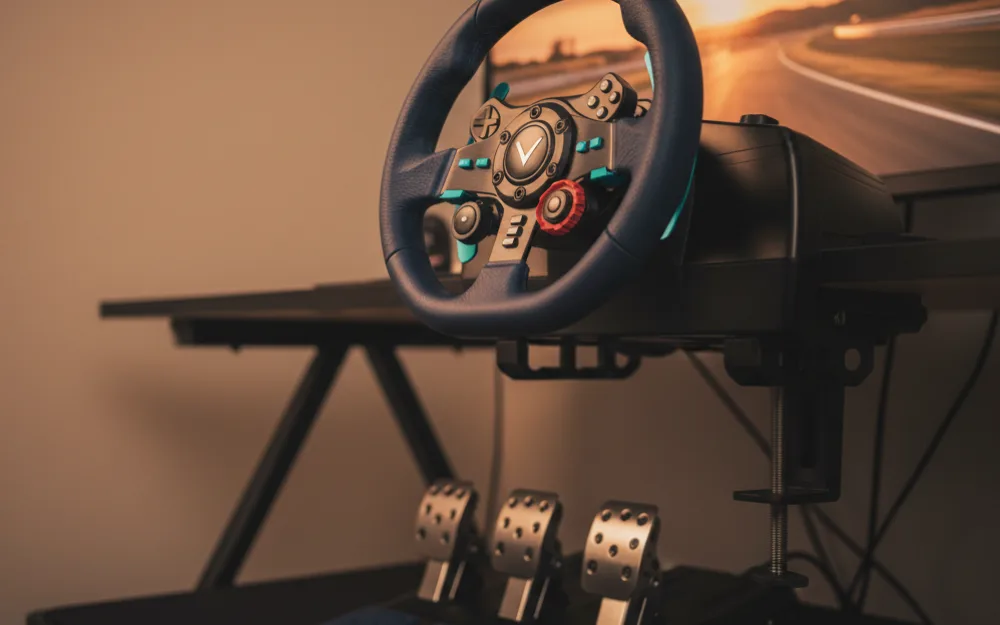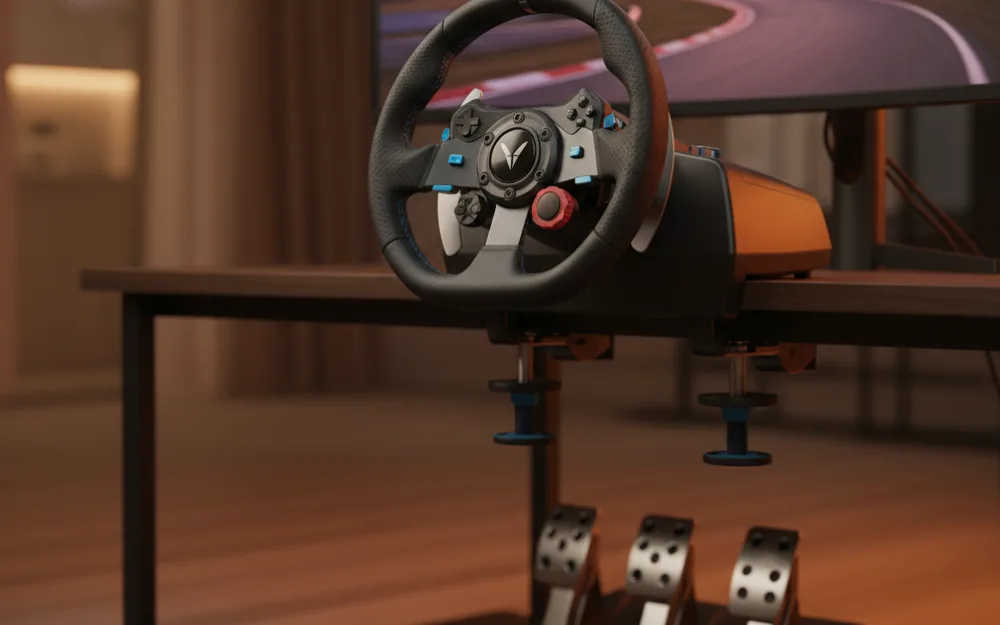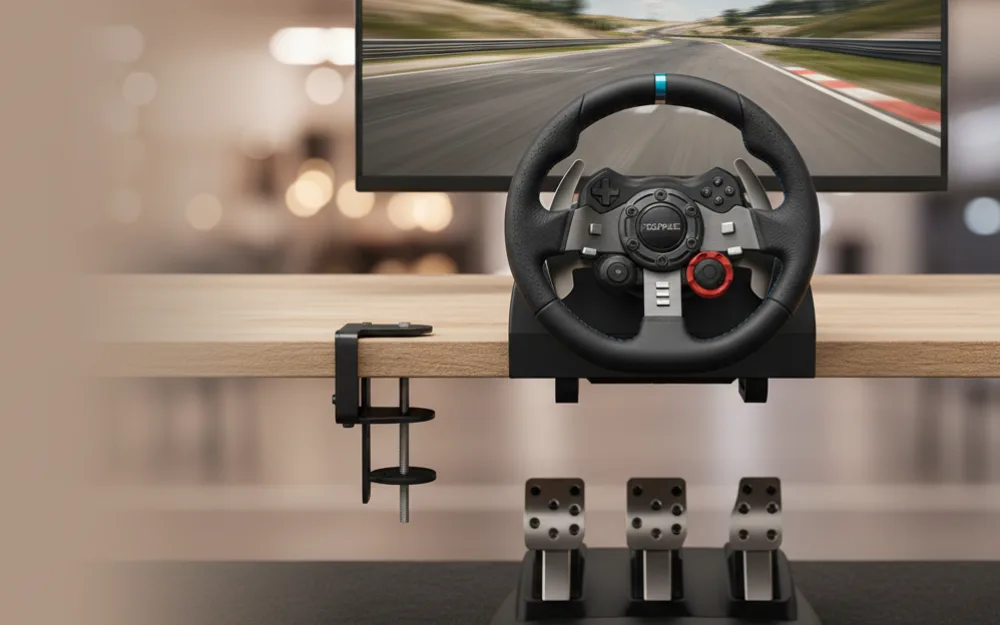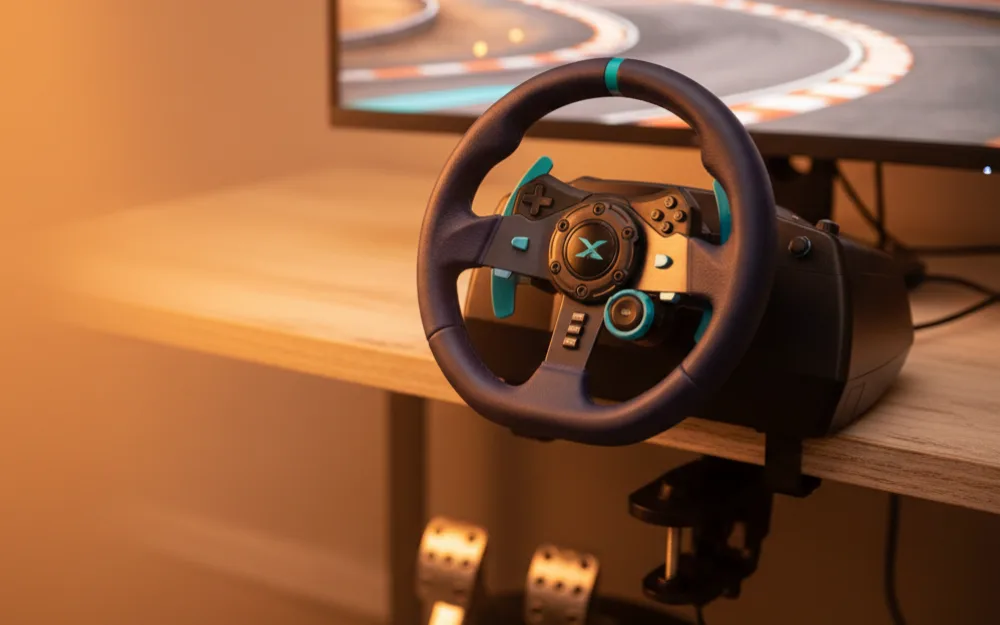


Here is the single most useful thing to know before you spend a cent in this bracket: under $150, no wheel gives you true force feedback. Real force feedback comes from a motor driving the rim, and a motor strong enough to matter costs more than the whole budget here. What you get instead is one of two simpler systems. Some of these wheels use a vibration motor that buzzes the rim on curbs and crashes, and some use spring centering, a mechanism that pulls the wheel back to straight with tension rather than reading the road. Both can teach you steering and racing lines honestly. Neither will tell you when the front tires start to slide. Once you accept that, choosing well at this price gets a lot easier.
This roundup covers the complete wheel and pedal bundles in our catalog that genuinely hold to a sub $150 budget, what each one asks you to accept in return, and who is better off saving for a wheel with a real motor instead. We compared manufacturer specifications with recurring owner feedback rather than our own driving time, and you can read how we review. If any of the vocabulary here is new, start with Getting Started.


Vibration or spring centering: what the feel really is
Before we judge any of these wheels, it helps to know how each one creates its feel, because the marketing rarely spells it out. A vibration wheel has a small motor that shakes the rim in response to game events, which adds drama on curbs and impacts but carries no directional force. A spring centered wheel uses a bungee or spring that resists as you turn and returns the wheel to center on its own, which gives you a sense of self aligning weight without any live information from the tires. A true force feedback base, the kind covered in our best sim racing wheels guide, drives the rim with a motor that can push back with real, changing force, so the wheel goes light when the front end washes wide and loads up as grip returns. That last behavior is the thing you are giving up at this price, and it is worth naming plainly rather than pretending a vibration buzz is the same feedback in a smaller dose.
How we picked
We set four criteria. It had to be a complete wheel and pedal bundle, not an accessory like a stand, shifter, or handbrake sold to pair with a wheel you already own. It had to list genuine platform compatibility rather than a vague claim, so you know it works on your console before it arrives. It had to hold under $150 on the merits, not through a temporary discount. And build quality plus a credible ownership record had to be good enough to trust for a first wheel that gets used hard. We looked at drive type, platform fit, the pedal set in the box, and how a wide pool of owners rate the hardware over time. We did not assign weighted scores, and the WSR Score you see on each card reflects verified buyer ratings, not an editorial rubric.
At a glance
| Wheel | Feedback type | Platforms | Best for |
|---|---|---|---|
| HORI Racing Wheel Apex | Spring centering | PS5, PS4, PC | PlayStation households wanting a licensed wheel |
| PXN V3 Pro | Vibration | Confirm on listing | Buyers who want a large, proven ownership record |
| Thrustmaster T98 Ferrari 296 GTB | Spring centering, linear resistance | PS5, PS4, PC | Beginners who want brand pedigree and Hall effect pedals |
| SUBSONIC 220RS-5 RGB | Vibration | PS5, PC | Open world and party players on PS5 |
| SUBSONIC SV250 | Basic entry | PS4, Xbox, Switch, Switch 2, PC | The widest console coverage and the lowest entry |
HORI Racing Wheel Apex
The HORI Racing Wheel Apex is officially licensed for PlayStation and lists compatibility across PS5, PS4, and PC, which is the headline reason to consider it. Official licensing means the hardware has to clear Sony’s own certification rather than relying on a generic USB profile, and that carries real weight on a budget wheel where other corners tend to get cut first. It uses spring centering rather than a motor, so it returns to straight cleanly and gives you a sense of steering weight, but it will not report a slide. The pros here are a trustworthy console handshake, a light, approachable feel that suits a living room setup, and one of the largest verified ownership pools of any wheel in this bracket, which makes its rating a settled read rather than an early guess. The cons are the missing directional feedback and a feel that leans entirely on spring tension, and HORI’s own product page lists no rumble feature, so do not count on curb or impact vibration the way a rumble wheel provides it. Confirm the exact rotation range and pedal type on the current listing before buying, since those details can shift between hardware revisions under the same name. It fits a PlayStation first player who wants a properly licensed wheel and is not chasing feedback yet.
PXN V3 Pro
The PXN V3 Pro takes the opposite path to trust: instead of leaning on a console license, it leans on volume, with over 5,000 verified ratings at a 4.2 average, a large and established ownership pool for an entry wheel. A rating built on that many purchases is harder to game than one built on a handful of early reviews, and it says something real about how the hardware holds up across a wide range of buyers rather than a small early group. It is the most affordable pick here with a vibration motor, so you get the curb and impact rumble that a pure spring wheel lacks, along with a wheel and pedal bundle positioned as a genuine first setup. The trade offs are simple pedals rather than the load cell brakes covered in our best sim racing pedals roundup, and vibration that adds drama without adding real steering information. Platform support varies by region and revision, so confirm your console on the current listing. It fits a value focused buyer who wants a large, established ownership record behind a first wheel.
Thrustmaster T98 Ferrari 296 GTB
The T98 is the brand name pick, an officially licensed Ferrari 296 GTB wheel and pedal set for PS5, PS4, and PC. Thrustmaster builds the feel around a bungee cord that gives linear resistance and automatic return to center, so effort rises smoothly and predictably as you turn rather than in the notchy way a cheap spring can. The rim runs 240 degrees of rotation with paddle shifters, and a Manettino style selector switches between three response profiles, which is a genuinely useful way to soften the wheel for a newcomer or sharpen it as you improve. The pedals use Hall effect sensors, a contactless design that resists wear better than the basic potentiometers common at this tier. The pros are the smooth linear resistance, the adjustable profiles, and the more durable pedal sensors. The cons are that it is still not force feedback, the rotation is short of the 900 degrees a road car uses, and the ownership record is smaller than the high volume budget wheels. It fits a beginner who wants recognizable brand pedigree and a cleaner return to center on PlayStation or PC.
SUBSONIC 220RS-5 RGB
The SUBSONIC 220RS-5 is the entry bundle built for the living room, with a compact rim of about 8.7 inches, a full set of face buttons, RGB lighting, and a vibration motor for curb and crash rumble. Its standout trick is a pair of onboard joysticks, which let you steer and control an on foot character at the same time, a real convenience for open world driving games where you hop in and out of the car. It ships with accelerator and brake pedals and mounts by suction cup, with clamp screws sold separately for a firmer hold. The catch is compatibility: this one covers PS5 and PC only, and it is not compatible with PS4, Xbox, or Switch, so check your platform first. The rotation is a short 180 degrees, which suits arcade handling more than a precise sim. The pros are the joystick convenience, the RGB flourish, and vibration feedback at a low entry. The cons are the narrow rotation, the suction mount, and PS5 or PC only support. It fits a PS5 owner who plays open world and party racers more than serious sims.
SUBSONIC SV250
The SV250 is the most affordable and most widely compatible wheel in the group, and its calling card is reach: it works across PS4, Xbox One, Xbox Series X and S, Nintendo Switch, Switch 2, and PC through plug and play USB, with no adapter required. That breadth is rare at any price and makes it the natural pick for a mixed console household or a younger player who moves between systems. It is a basic entry wheel, with accelerator and brake pedals, a rubberized non slip grip, and a desk clamp that holds on tables up to about 1.6 inches thick. The pros are the sheer platform coverage, the lowest cost of entry, and a simple setup a child can manage. The cons are the plainest feel of the group, a short rotation range, and a build meant for casual sessions rather than committed racing. One important note: it does not support PS5, so PlayStation 5 owners should look at the 220RS-5 above instead. It fits a first time or family buyer who values the widest compatibility and the gentlest price over feel.
Who should skip a wheel at this price
| A sub $150 wheel fits you if | Save and step up if |
|---|---|
| You are new to wheels and want to learn steering and lines | You want to feel the front tires load and slide through the rim |
| You mostly play arcade or open world racers on a console | You race iRacing, Assetto Corsa Competizione, or ranked sims seriously |
| You want a low commitment way to find out if the hobby sticks | You will resent buying twice and would rather start with real feedback |
If you land in the right column, the honest advice is to skip this tier entirely. A serious sim racer learns car control through the force the wheel feeds back, and none of these wheels can provide it. Put the money toward a belt driven or entry direct drive wheel instead, where the motor actually communicates grip. Our best sim racing wheels guide covers that field, and the belt and gear driven wheels category is the natural next step up when your budget grows.
How it scores
The WSR Score shown on each card reflects verified buyer ratings gathered and normalized on a consistent scale, not an editorial rubric. You can read what goes into it on How We Review. On that basis these wheels rate as solid entry hardware, with the Ferrari licensed Thrustmaster carrying the highest rating, the licensed HORI pairing a strong rating with the deepest verified ownership record in this group, and the value focused PXN close behind on both. Keep the scale in mind: a strong score for an entry wheel measures how well it satisfies budget buyers, not how it stands against a direct drive base.
Where to go from here
If this is your first wheel purchase of any kind, our best racing wheel for beginners guide walks through what actually matters at each price point. If your budget grows past this tier, the best sim racing wheels roundup covers the wider field where real force feedback and metal internals become standard rather than optional. And once the wheel is sorted, our best sim racing pedals roundup and the belt and gear driven wheels category are the natural next stops for upgrading one piece at a time instead of replacing the whole setup at once.