
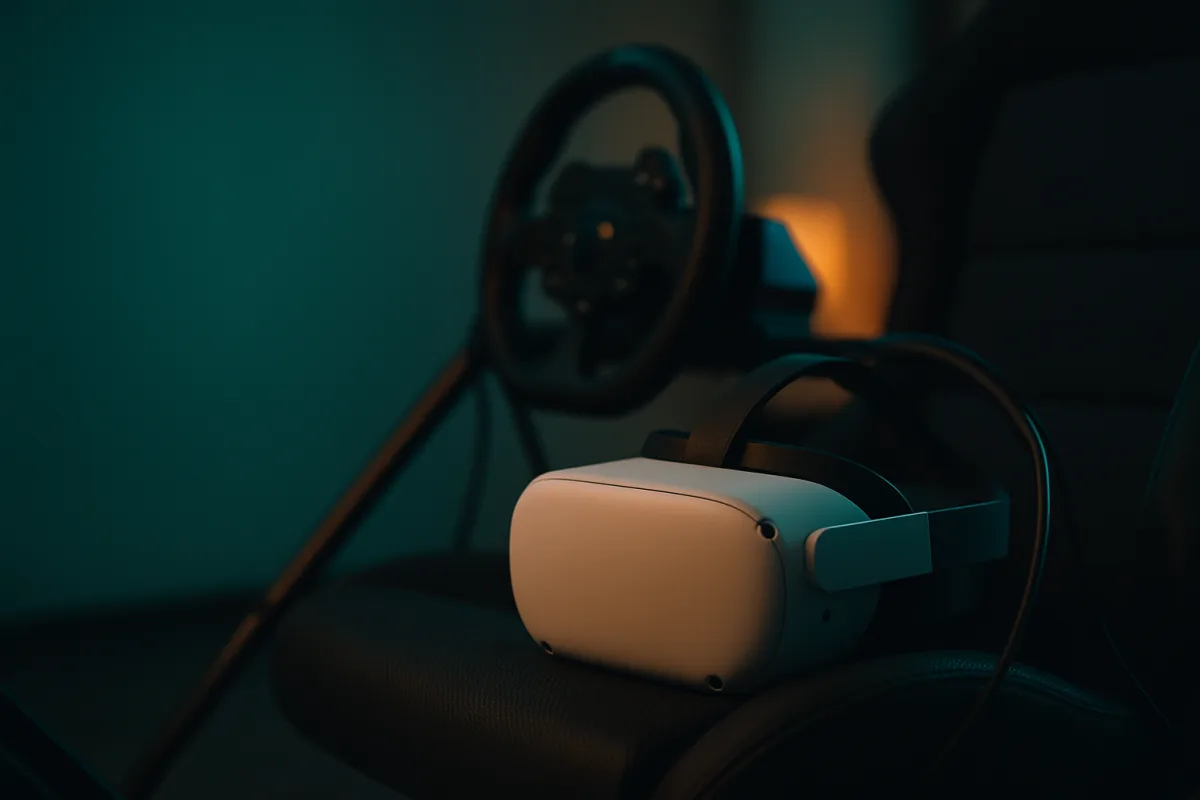

The short answer: the Meta Quest 3 is the VR headset most PC sim racers should buy, because it pairs a sharp 2064 x 2208 per eye display with the largest ecosystem, and a link cable turns it into a PC headset for iRacing, Assetto Corsa, and Automobilista 2. The Quest 3S is the budget version with a lower resolution panel. On PlayStation 5, the PlayStation VR2 is the only choice, and it is a very good one for Gran Turismo 7. If clarity is everything and the PC can feed it, the Pimax Crystal Light and Crystal Super are the simulation specialists.
VR is the cheapest way to get a true 1:1 sense of scale and a full field of view in a sim; it also has real costs in GPU load, comfort, and resolution compared with a big monitor. This guide compares six headsets and two accessories sold new in the US on per eye resolution, refresh rate, tracking, weight, platform, and owner feedback, using the method on our How We Review page. If you would rather stay on a screen, the monitor guide is the companion piece.



Comparison at a Glance
| Headset | Per eye resolution (listing) | Display | Refresh (listing) | Tracking | Platform | Weight (listing) | Warranty (listing) |
|---|---|---|---|---|---|---|---|
| Meta Quest 3 (512 GB) | 2064 x 2208 | LCD (pancake lenses) | Not stated on listing | Inside out | Standalone; PC via cable or Wi-Fi | Not stated on listing | 1 year |
| Meta Quest 3S (128 GB) | 1832 x 1920 | LCD | Not stated on listing | Inside out | Standalone; PC via cable or Wi-Fi | 515 g | 1 year |
| PlayStation VR2 | 2000 x 2040 | OLED, HDR | Not stated on listing | Inside out, eye tracking | PS5 (PC with Sony’s separately sold adapter) | Not stated on listing | 1 year |
| PlayStation VR2 Horizon bundle | 2000 x 2040 (same headset) | OLED, HDR | Not stated on listing | Inside out, eye tracking | PS5 | Not stated on listing | Not stated on listing |
| Pimax Crystal Light | 2880 x 2880 | QLED with local dimming | Up to 120 Hz | Inside out | PC (SteamVR) | About 815 g | 1 year |
| Pimax Crystal Super | 3840 x 3840 | QLED with Mini LED local dimming | Up to 90 Hz | Inside out, eye tracking | PC (DisplayPort) | Not stated on listing | 1 year |
| Syntech Link Cable (16 ft) | Accessory | USB 3.0, 5 Gbps | Not applicable | Not applicable | Quest 3, 3S, 2, Pico 4 | Not applicable | Not stated |
| BOBOVR M3 Pro head strap | Accessory | Battery strap, 5,200 mAh | Not applicable | Not applicable | Quest 3, 3S | 430 g | 18 months |
Figures come from the Amazon listings, which are inconsistent on refresh rate and weight, so the table says “not stated” where the listing is silent rather than filling in numbers from elsewhere. The Quest 3S listing quotes a lower per eye resolution than the Quest 3, which is the main difference between the two.
How We Picked
We included headsets sold new in the US that are commonly used for sim racing, covering standalone, console, and PC only designs, plus the two accessories most Quest owners buy for a rig. Each headset was assessed on per eye resolution and pixel density, refresh rate, lens clarity as owners describe it, tracking type, comfort and weight, platform lock-in, and the GPU it realistically needs.
Each product’s WSR Score comes from verified buyer feedback, normalized to our 10-point scale. See how we review for details.
Meta Quest 3 (512 GB)
The Quest 3 lists 2064 x 2208 per eye, a Snapdragon XR2 Gen 2 processor, 8 GB of RAM, inside out tracking, and full color passthrough. For sim racing it works as a PC headset over a USB 3 link cable or Wi-Fi, which means every SteamVR racing title runs on it. The 512 GB storage matters little for racing; the appeal is the display and the ecosystem.
- Pro: sharp panel and pancake lenses with a wide sweet spot for reading dashboards
- Pro: works standalone and as a PC headset; huge owner base
- Con: compression over link adds slight softness versus DisplayPort headsets
- Con: the stock strap and battery life suit short sessions; see the accessories
PC sim racers who want the best all-round headset and may also use it away from the rig.
You race only on PS5, or you want uncompressed maximum clarity (Pimax).
Meta Quest 3S (128 GB)
The 3S shares the XR2 Gen 2 processor and 8 GB of RAM but uses a 1832 x 1920 per eye display and weighs 515 g on the listing. It works as a PC headset the same way as the Quest 3, so it is the lowest cost route into PC VR racing from a major brand.
- Pro: same processor and PC link path as the Quest 3 at a lower price
- Pro: large owner base and accessories shared with the Quest 3
- Con: lower resolution makes distant braking boards and mirrors harder to read
- Con: 128 GB fills quickly if you also use it standalone
Budget PC racers trying VR for the first time.
Clarity matters; the Quest 3 panel is the upgrade you would want within months.
PlayStation VR2
PSVR2 lists 2000 x 2040 per eye OLED with HDR, a 110 degree field of view, eye tracking, headset haptics, and 3D audio, and it plugs into a PS5 with a single cable. Gran Turismo 7 supports it natively. Sony sells a separate PC adapter that enables SteamVR use, although eye tracking and HDR do not carry over to PC.
- Pro: OLED contrast and the only VR option for Gran Turismo 7
- Pro: single cable setup on PS5
- Con: PC use requires Sony’s adapter and loses some features
- Con: Fresnel style lenses have a smaller sweet spot than the Quest 3
PS5 owners, especially Gran Turismo 7 players.
You race on PC only; the Quest 3 is simpler there.
PlayStation VR2 Horizon Call of the Mountain bundle
The same headset packaged with Horizon Call of the Mountain. The listing details are sparse and partly in another language, so rely on the standalone PSVR2 listing for specifications. Buy whichever is cheaper on the day; the game is a bonus, not a reason.
- Pro: same hardware as the standalone PSVR2
- Pro: includes a showcase title
- Con: listing specifications are incomplete
- Con: no racing content in the bundle
PS5 buyers when the bundle is discounted below the plain headset.
It costs more than the standalone headset.
Pimax Crystal Light
The Crystal Light is a PC only headset with 2880 x 2880 per eye QLED panels with local dimming, glass aspheric lenses, up to 120 Hz, inside out tracking, and a DisplayPort connection through SteamVR. It weighs about 815 g. Owner feedback on Amazon is mixed, with setup and software the recurring theme, so it suits patient PC users rather than first time VR buyers.
- Pro: far higher resolution than the Quest 3, uncompressed over DisplayPort
- Pro: glass lenses and 120 Hz
- Con: heavy, and owner feedback on software is mixed
- Con: needs a high end GPU to run at native resolution
Simulation focused PC racers with a strong GPU who prioritize clarity.
You want plug and play; the Quest 3 is far less fuss.
Pimax Crystal Super
The Crystal Super pushes to 3840 x 3840 per eye with QLED and Mini LED local dimming, 50 pixels per degree, a 140 degree field of view, eye tracking with dynamic foveated rendering, and refresh up to 90 Hz over DisplayPort. It is the sharpest headset here and the most demanding on the PC.
- Pro: the highest resolution and widest field of view on this list
- Pro: eye tracking for foveated rendering
- Con: 90 Hz ceiling and a top tier GPU requirement
- Con: the most expensive headset here with limited Amazon feedback
Enthusiasts building a no compromise PC VR rig.
Your GPU is anything less than flagship class.
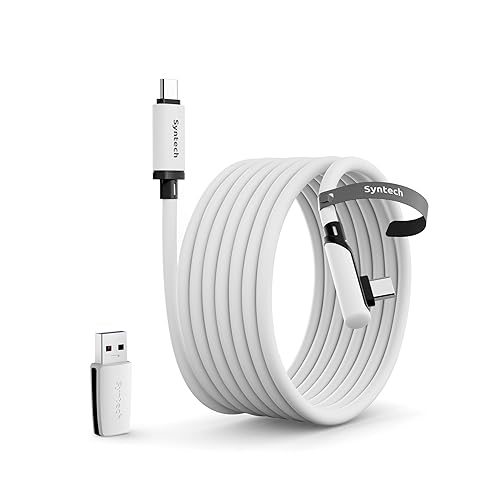
Syntech Link Cable (16 ft)
A 16 foot USB 3.0 Type-C cable with a USB-A adapter, rated for 5 Gbps and compatible with the Quest 3, 3S, 2, and Pico 4. A wired link avoids the Wi-Fi variability that causes stutter in racing, and 16 feet reaches from a PC to a cockpit comfortably.
- Pro: inexpensive, long, and widely used
- Pro: USB-A adapter included
- Con: the listing says it is a data cable, not a charging cable, so the battery still drains in long sessions
- Con: cable management on a rig takes planning
Every Quest owner who races on PC.
Your PC and rig share a room with a strong Wi-Fi 6 router and you prefer wireless.
BOBOVR M3 Pro Battery Head Strap
The M3 Pro replaces the Quest 3 and 3S strap with a rigid halo design that moves weight off the face and adds a magnetic, hot swappable 5,200 mAh battery pack rated for roughly two more hours. It carries an 18 month warranty and is one of the most reviewed Quest accessories on Amazon.
- Pro: solves the two Quest complaints, comfort and battery, in one part
- Pro: swappable batteries for long sessions
- Con: adds weight at the back of the head
- Con: third party; no Meta warranty coverage
Quest 3 and 3S racers who run long stints.
You only do short sessions and the stock strap is fine.
Buying Guide
Platform first
PS5 racers have one option, PSVR2. Xbox has no VR. PC racers choose between Quest (standalone plus link), Pimax (DisplayPort, PC only), or PSVR2 with Sony’s adapter.
Resolution and GPU
VR renders two images at high resolution, so a headset that reads clearly needs a strong graphics card. The Quest 3 is comfortable on a mid-range card; the Pimax headsets need the high end. Our Gaming PCs category covers what to expect.
Comfort and sessions
Sim racing sessions are long and your head barely moves, so weight distribution and lens sweet spot matter more than in room scale games. A halo strap for the Quest is close to essential. Motion sickness is rare in cockpit games because your body is seated and the horizon behaves, but start with short sessions.
Who Should Not Buy
Xbox racers have no VR path. Racers who want to read distant text and mirrors easily may still prefer a large monitor. And if your GPU is more than a few years old, a headset will expose it; upgrade the PC before the headset.
Frequently Asked Questions
Does the Meta Quest 3 work with iRacing?
Yes, as a PC headset over a link cable or Wi-Fi. iRacing runs on the PC and streams to the headset.
Can I use PSVR2 on PC?
Yes, with Sony’s separately sold PC adapter and a DisplayPort connection, through SteamVR. Eye tracking, HDR, and headset haptics are not available on PC.
Quest 3 or Quest 3S for racing?
The Quest 3. Its higher resolution panel makes braking markers, mirrors, and dashboards readable, which is where the 3S falls short.
Is VR better than triple monitors?
VR gives depth and scale that no screen can; triples give sharper detail and no headset on your face. Many racers own both and choose by session length.
Sources
- Meta product listings for the Quest 3 and Quest 3S
- Sony product listings for PlayStation VR2 and the Horizon bundle
- Pimax product listings for the Crystal Light and Crystal Super
- Syntech and BOBOVR product listings for the link cable and M3 Pro strap
- September 2026: first published with six headsets and two accessories.