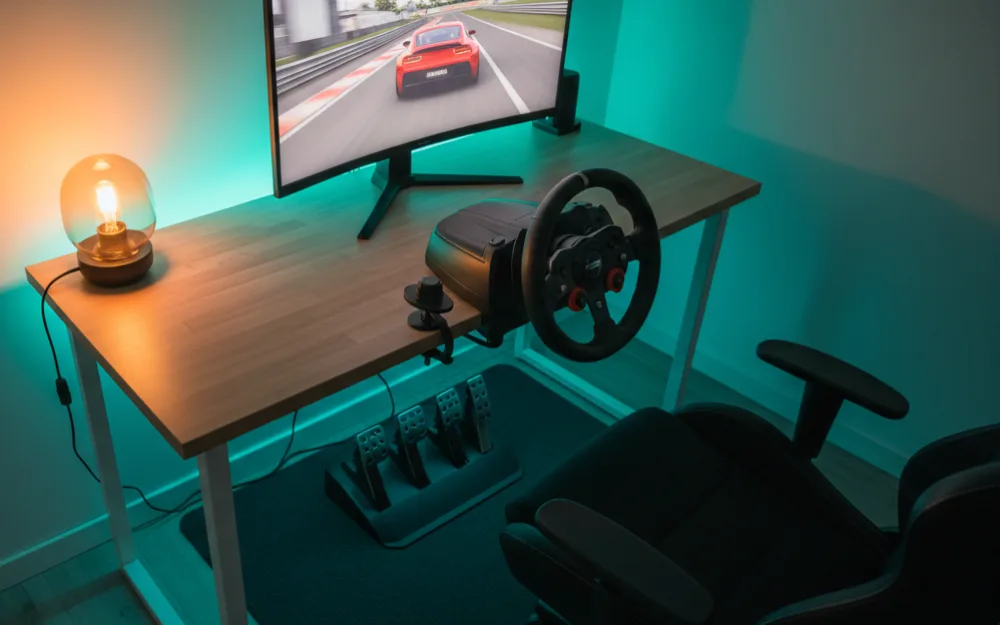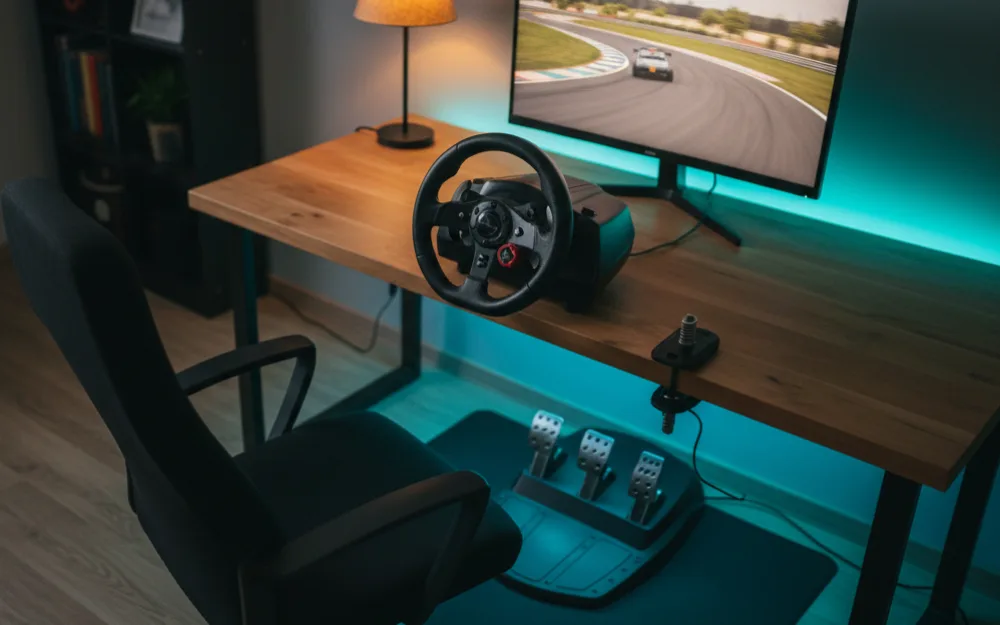

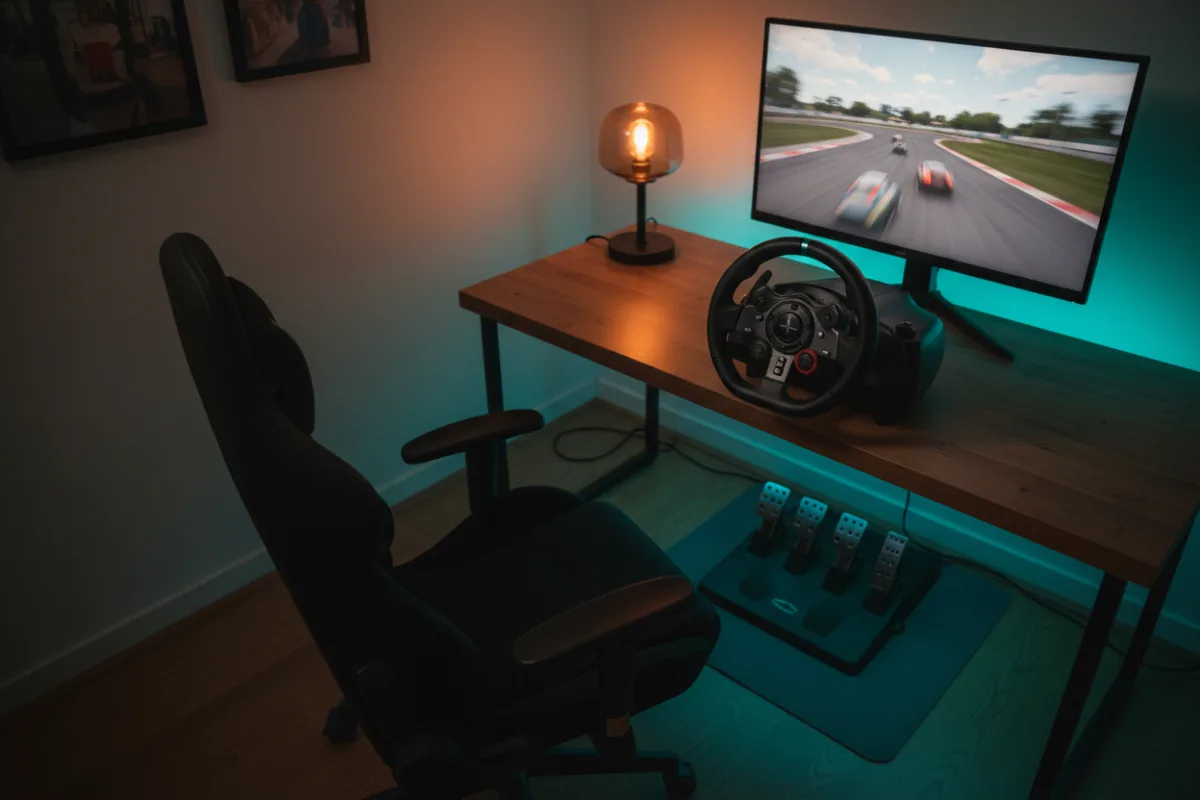

This guide builds the no compromise sim racing setup for under $5000, the tier where you stop asking what to leave out and start asking what you genuinely need. The honest truth up front: most drivers do not need to spend this much, and the extra money buys refinement rather than a linear jump in fun. What it does buy is the strongest practical direct drive base, premium pedals with real bite, a display that pulls you fully into the car, and a dedicated PC that can drive all of it without stutter. Before you commit, be clear about why you are here. This build makes sense if you race seriously, chase small gains, and want a rig that will outlast several upgrade cycles. If that is not you, the tier below is likely enough.
These recommendations come from comparing this budget against the parts experienced racers recommend at the top of the hobby, and you can read how we review. If you are still shaping your rig, start with Getting Started. The natural step below this one is our sim racing setup under $3000 guide, and most of what changes at this tier is depth rather than a different shopping list.
What actually changes at this tier
Three things separate this build from the tier below, and it helps to name them plainly. First, the direct drive base moves to the strongest torque most drivers will ever want. Second, the pedals step up to a premium load cell set with a firmer, more precise brake. Third, and this is the part people skip, you add a dedicated PC built to run demanding sims at high frame rates on triple screens or a QD-OLED panel. Everything else, the cockpit and the display, is a refined version of the previous tier rather than a new category. Keep that in mind as you spend, because it is easy to over invest in one showpiece part and starve the PC that has to feed it.
A no compromise build under $5000
The build below leads with a strong direct drive base, adds a premium load cell pedal set, and pairs both with a dedicated gaming PC so the whole rig runs at the frame rate serious racing needs. Mount it all on a stiff aluminum profile cockpit and finish with the display of your choice. Treat the base, the pedals, and the PC as the three decisions that define this tier.


The wheel base: step up to the strongest torque
At this tier the base moves to the top of the practical range. The MOZA R12 V2 bundle delivers 12 Nm of servo direct drive torque and arrives with a KS wheel, which replicates the steering force of a road or race car with detailed feedback from the virtual track surface. That is more force than the vast majority of drivers use day to day, so understand what the extra headroom is for: strong curb strikes, heavy formula cars, and the reserve to run high forces without the base straining. One honest caveat: the R12 V2 is a newer bundle with a thin ownership record so far, so there is less long term owner feedback to lean on than with older bases. If you want a longer track record, a proven 12 Nm class base from the previous tier is a reasonable and well understood choice. Because a base this strong can genuinely hurt a wrist, set the torque conservatively at first, build up slowly, grip the wheel firmly with both hands during the calibration sweep, and turn the force well down if a child ever uses the rig. Compare the field in the best direct drive wheels, and read how much torque do you need before assuming more is better.
The pedals: premium load cell with real bite
The pedals are where this budget pays off most obviously. The ASETEK SimSports Forte set uses a load cell brake in a die-cast aluminum body with a zero play brake and throttle, rated to withstand 440 pounds of foot force and a burst pressure of up to 1,543 pounds, and rated for up to a million activations, which is why owners describe the brake as firm, precise, and immovable under hard use. It ships with interchangeable elastomers, an integrated physical stop, and an expansion chamber to shape the pedal feel, and it can be upgraded to the Invicta set later without replacing the whole unit. If you want to stay in one ecosystem alongside a MOZA base, the MOZA CRP2 load cell pedals are a natural in house alternative, though as a newer release they carry very little owner feedback so far, so weigh them accordingly. Whichever you choose, a premium brake rewards a trained right foot with braking you can repeat corner after corner. See the best load cell pedals to compare, and how to calibrate sim racing pedals to set them up well.
The PC: the part people forget to budget for
A rig this capable is only as good as the PC feeding it, and this is the most common gap at the top of the budget. Triple screens and high refresh panels demand real graphics power, and a PC that cannot hold a high frame rate turns a premium display into a stuttering one. The Skytech King 95 pairs a Ryzen 7 9800X3D processor with an NVIDIA RTX 5070 Ti 16GB graphics card, 32GB of DDR5 6000 memory, a 2TB Gen4 NVMe drive, and a 360mm liquid cooler, which is a strong match for high frame rate racing at 1440p and a capable base for triples. The MSI Codex Z2 offers a Ryzen 7 8700F with an RTX 5070 12GB card, 32GB of DDR5, and a 2TB drive as a slightly more measured option. Size the PC to your display plan: triple high refresh screens ask more of the graphics card than a single panel, so if you intend to run three screens or VR, lean toward the stronger machine. For the full picture, see the best gaming PC for sim racing under $2500 and the wider best gaming PC for sim racing guide.
The cockpit and display: refine, do not reinvent
The frame and the screen carry over from the previous tier, refined rather than replaced. A stiff aluminum profile cockpit is still the right foundation, and at this budget you can choose a heavier gauge frame with a proper racing seat for a driving position that holds under a 12 Nm base. For the display, the two strong paths are triple QD-OLED panels for a wraparound view with deep contrast, or a high end VR headset for full immersion in the cockpit. Reviewers and owners tend to agree this comes down to preference rather than a single correct answer: triples give you a shared, stable image and easier button and dash visibility, while VR gives unmatched depth and presence at the cost of comfort over long stints. Compare frames in the best aluminum profile cockpit guide, screens in the best QD-OLED monitor for sim racing, and headsets in the best VR headset for PC sim racing.
How the budget breaks down
As with the tier below, think in proportions rather than fixed dollars, since prices shift and a sale can change the whole shape. The rough split that keeps this build balanced looks like this.
| Part | Share of the budget | Why it earns its place |
|---|---|---|
| Direct drive base and rim | The largest single slice | Strongest practical torque with headroom for heavy cars and curbs |
| Premium load cell pedals | A large slice | Firm, precise braking you can repeat under real force |
| Dedicated gaming PC | A large slice, do not shortchange it | Feeds triples or VR at the frame rate serious racing needs |
| Cockpit and display | The remaining slice, sized to your goal | Rigid frame plus triple QD-OLED or VR for immersion |
The honest talk about diminishing returns
Here is the part most build guides skip. The jump from an entry rig to a midrange one transforms how you drive. The jump from there to this top tier refines it. The extra money buys stiffness, braking precision, display quality, and the graphics power to run it all smoothly, but it does not add fun in a straight line, and a stronger base past a certain point mostly adds reserve you may never fully use. Spend the top of this budget where you will actually feel it: a premium brake you press on every corner, and a PC that keeps the frame rate rock steady. Be more cautious about paying for the last newton meter of torque or the largest possible screen if the rest of the chain cannot keep up with it.
Who should stop at a lower tier
Most racers should stop at the tier below, and that is the honest recommendation. The sim racing setup under $3000 build already gives you a strong direct drive base, a load cell brake, a rigid frame, and a serious display, which is more than enough for the vast majority of drivers. Step up to this top tier only if you compete seriously, want triple QD-OLED or VR with a PC built to drive it, and will use the extra headroom rather than admire it. If you are buying at this level mostly for the badge value of the strongest parts, put the difference into practice time and a coaching program instead, because seat time returns more lap time than hardware does past this point. The table below sorts out who this build fits.
| This build is right if | Stay at a lower tier if |
|---|---|
| You compete seriously and chase small, repeatable gains | You race for fun and do not track lap time closely |
| You want triple QD-OLED or VR and a PC built to drive it | A single strong panel already satisfies you |
| You will use the torque headroom on heavy cars and hard curb strikes | You mostly race lighter cars where extra torque sits unused |
| You want a rig that will outlast several upgrade cycles | You would feel the money more as practice time and coaching |
Your next step
Choose the direct drive base, premium pedals, and a PC sized to your display first, then refine the cockpit and screen around them. If you are not sure this tier is worth it for you, start with the sim racing setup under $3000 build and upgrade only the parts you outgrow, and new builders can find the fundamentals under Getting Started.