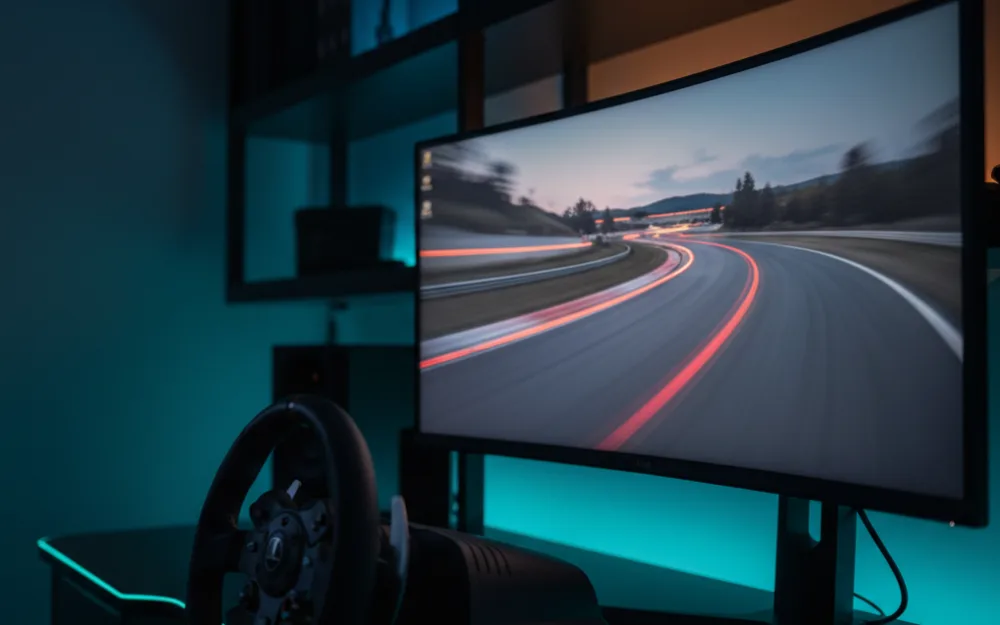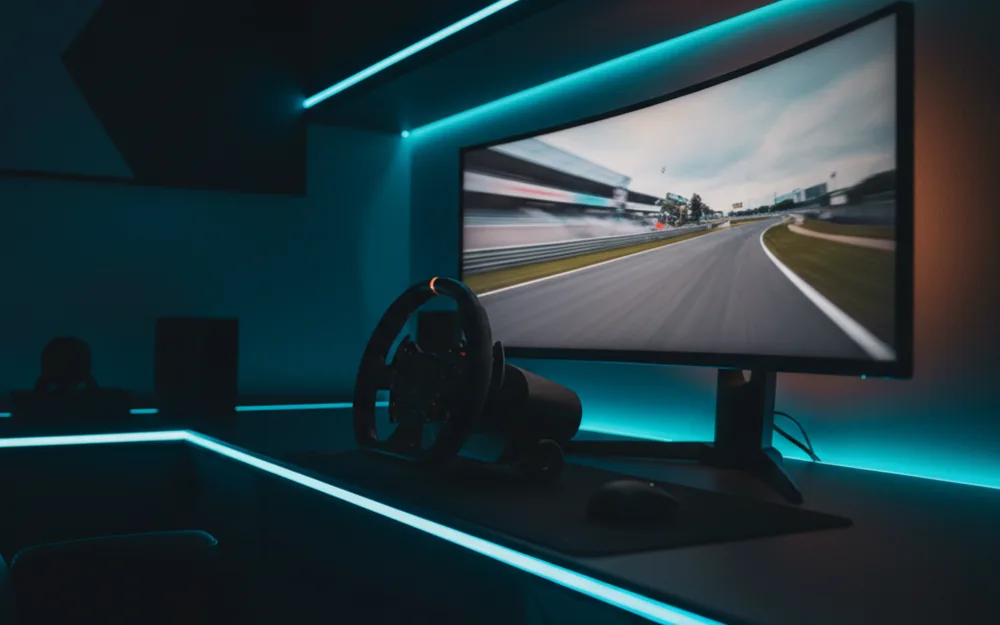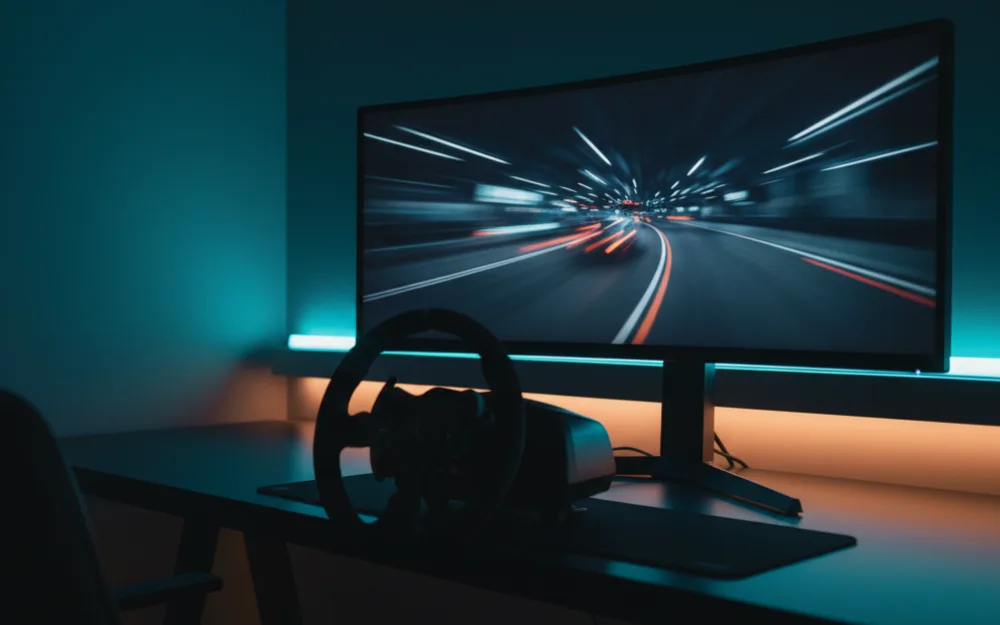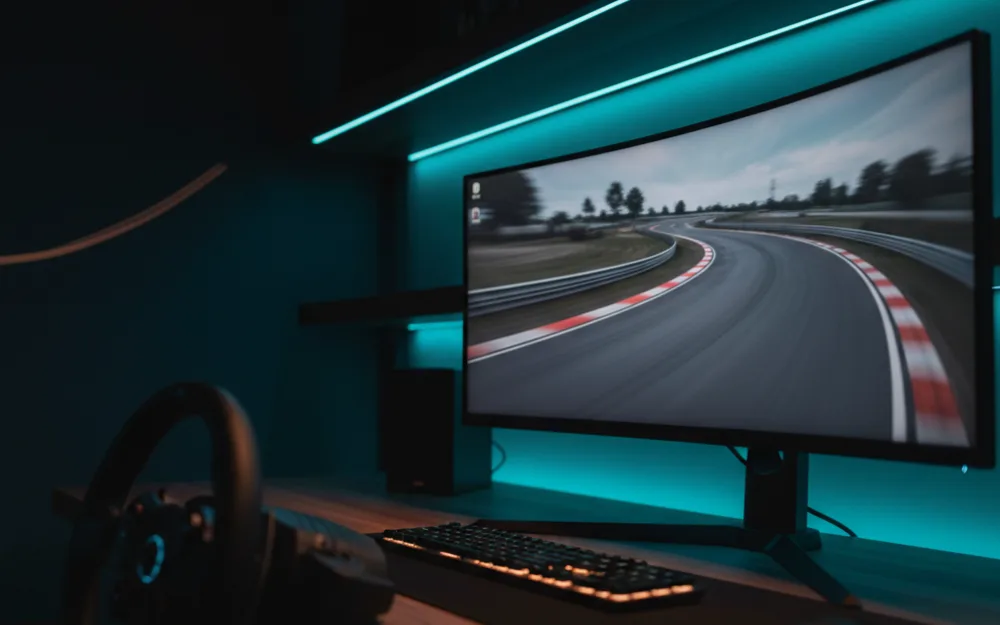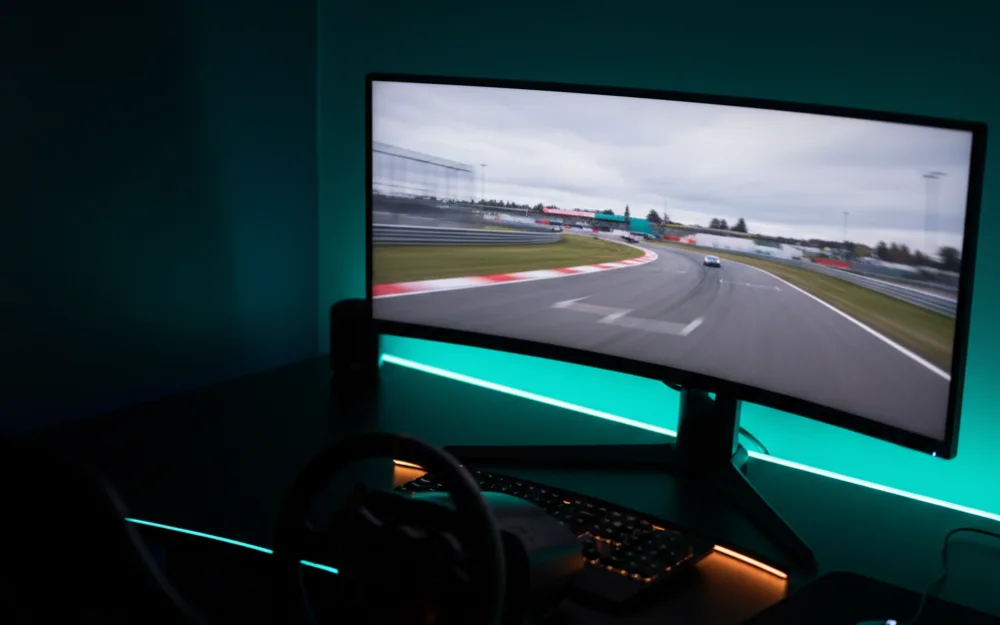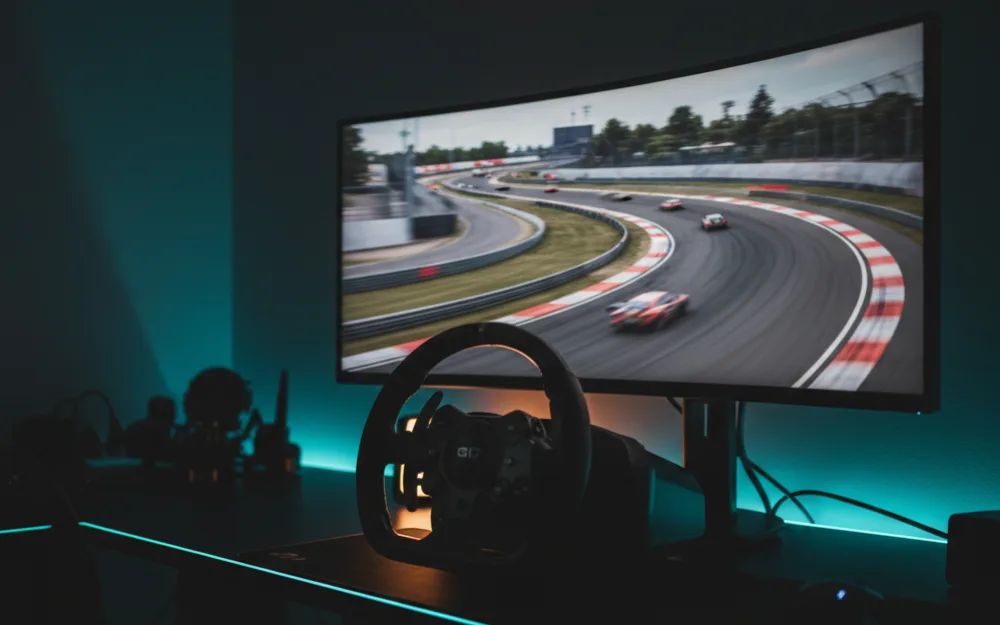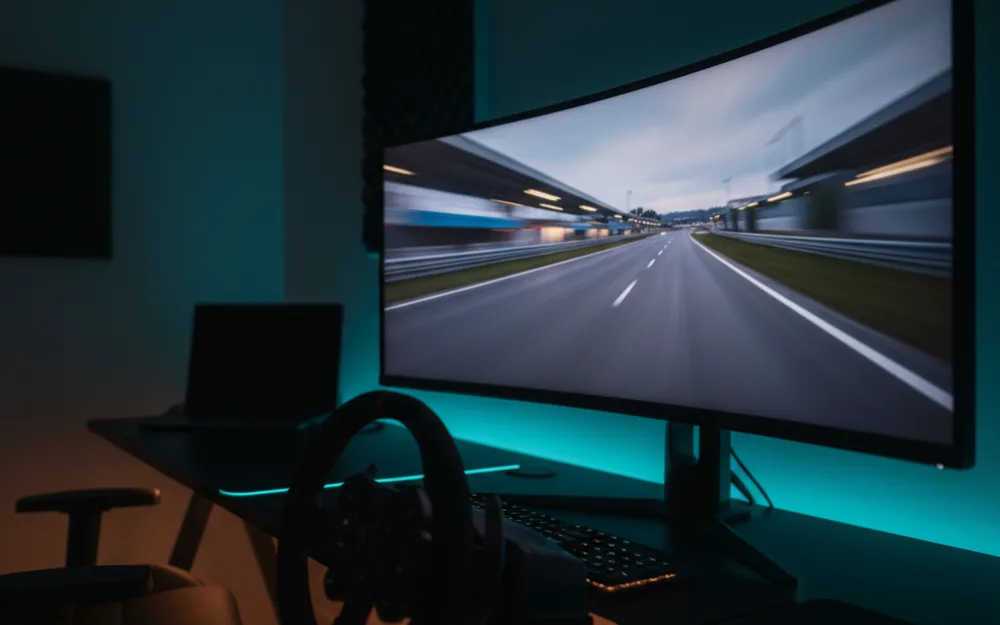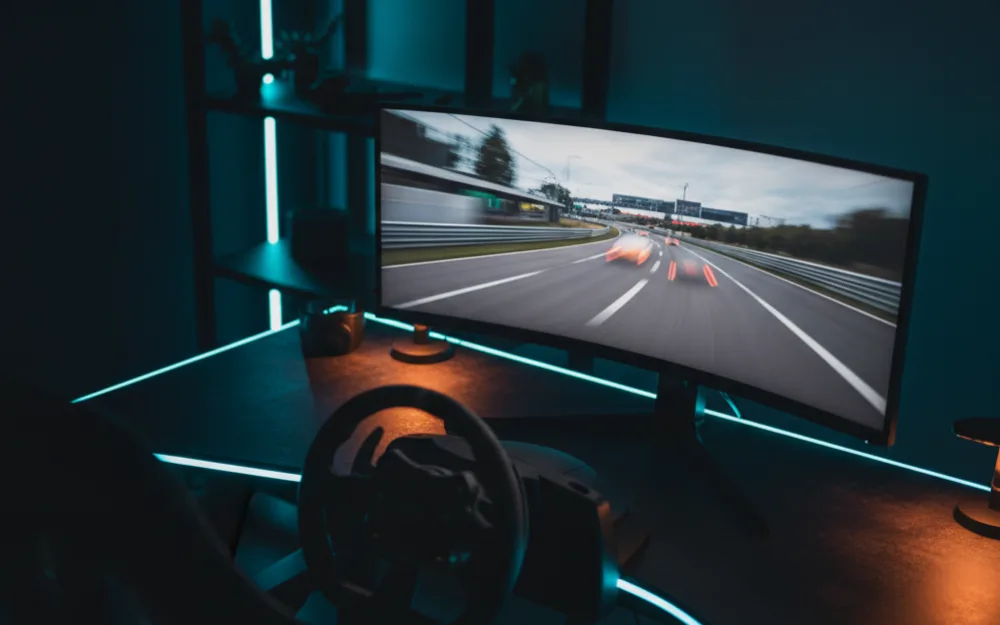


QD-OLED is a specific panel family, and if you have landed here you probably want that family on purpose rather than any screen the marketing calls OLED. It starts with a blue OLED emissive layer and converts that light through a quantum dot layer into pure red, green, and blue subpixels, with no white subpixel added to lift brightness. That structure is the reason QD-OLED holds its color saturation as the picture gets brighter, which is where it separates from a white OLED panel, and it keeps the per pixel black level that makes a night race look genuinely dark rather than dark gray. This roundup ranks confirmed QD-OLED monitors for a sim racing desk, and it stays inside the QD-OLED family on purpose, so if you are cross shopping LCD you are in the wrong list.
We compared manufacturer specifications against measurements reported by independent review outlets and recurring owner feedback rather than ranking these from our own screen time, and you can read how we review. Two questions decide most QD-OLED purchases: how the panel handles static dashboard and HUD elements over the long haul, and how long the warranty covers the panel if image retention does show up. We weight both, alongside the usual refresh and resolution math, and if you are still working out how much screen width you need first, our guide to field of view (FOV) is the better place to start.


How we picked
First, panel type had to be confirmed as QD-OLED specifically, since an ultrawide listing can use the word OLED for a white OLED panel with a color filter instead of a quantum dot layer. From there we looked at resolution against size, because a 4K panel and a WQHD ultrawide put pixels in very different places. Refresh rate and adaptive sync certification came next, since a headline refresh number only helps if the panel is validated to sync cleanly with your graphics card at frame rates you can actually sustain. Then we weighed the two QD-OLED specific concerns directly: the coating, because a glossy panel and a matte panel behave very differently under a lamp, and the burn-in mitigation plus warranty length, because a static rev counter or map is exactly the kind of element that stresses any emissive panel over years of use.
At a glance
| Model | Size and ratio | Resolution | Refresh | Coating | Panel warranty |
|---|---|---|---|---|---|
| MSI MPG 321CURX | 32 inch, 16:9 | 3840 x 2160 (4K) | 240 Hz | Glossy | 3 year |
| Alienware AW3425DW | 34.2 inch, 21:9 | 3440 x 1440 | 240 Hz | Matte | 3 year |
| MSI MAG 341CQP | 34 inch, 21:9 | 3440 x 1440 | High refresh | Anti-reflection | See listing |
| Samsung Odyssey OLED G8 | 34 inch, 21:9 | 3440 x 1440 | 175 Hz | Glare free | 3 year |
| Alienware AW3423DWF | 34 inch, 21:9 | 3440 x 1440 | Lower than the 240 Hz pair | Matte | See listing |
MSI MPG 321CURX: the sharpest QD-OLED for detail
The 321CURX is the outlier here, a 32 inch, 16:9 QD-OLED at a full 4K resolution of 3840 by 2160, running 240 Hz with a rated 0.03 ms response and contrast of 1,500,000 to 1. For a racer who cares most about clarity, this is the pick, because packing that many pixels into 32 inches gives the highest pixel density in this roundup, and reviewers who evaluate QD-OLED panels point to that density as the reason distant apex boards and mirror detail stay crisp. It carries a glossy finish, which deepens perceived contrast in a controlled room, and that is also the caveat: a glossy QD-OLED shows reflections a matte panel would scatter, so a bright window behind you will fight the image. It also asks the most of your graphics card, since sustaining high frame rates at 4K is a heavier load than any ultrawide here, and MSI backs it with OLED Care burn-in mitigation and a 3 year warranty.
Alienware AW3425DW: the fastest 34 inch QD-OLED
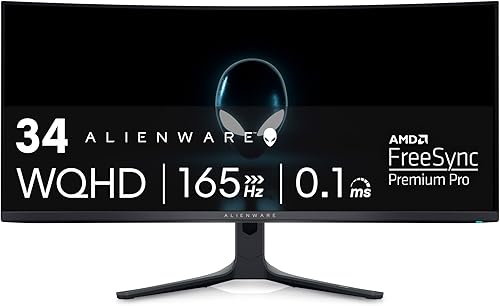
The AW3425DW is a 34.2 inch, 21:9 QD-OLED at 3440 by 1440, rated at 240 Hz with a 0.03 ms response, an 1800R curve, 99.3% DCI-P3 color, and contrast of 1,500,000 to 1. For close, wheel to wheel racing where quick side by side motion is easy to misread, reviewers who compare QD-OLED panels consistently flag the combination of that refresh ceiling and near instant pixel response as the standout. Unlike the glossy 321CURX, it uses a matte finish, so it holds up better under some ambient light at the cost of a slightly softer sense of contrast. The honest caveat is GPU demand: 240 fps at 3440 by 1440 is a real workload, and Dell certifies it as FreeSync Premium Pro and G-Sync Compatible with a 3 year warranty that covers the panel.
MSI MAG 341CQP: the connectivity value pick
The MAG 341CQP brings the 34 inch, 3440 by 1440 QD-OLED formula to a lower price tier while keeping a high refresh and an anti-reflection coating. Its distinguishing feature is connectivity: it adds a KVM feature and a Console Mode HDMI path, which is genuinely useful on a desk that mixes a racing PC with a console or a second machine, and our MSI MAG 341CQP review goes deeper on that. The caveat is that it lacks the official G-Sync Compatible certification the AW3425DW carries, so it suits a buyer who values the extra ports and the lower entry point over the fastest, most broadly certified panel. Confirm the exact refresh and warranty on the current listing before you commit, since MSI has shipped more than one QD-OLED at this size.
Samsung Odyssey OLED G8: the premium panel with smart features
The Odyssey OLED G8 is a 34 inch, 21:9 QD-OLED at 3440 by 1440, running 175 Hz with a 0.03 ms response, HDR10+ support, and contrast of 1,000,000 to 1. Its two standout traits are a glare free coating that scatters reflections more aggressively than a standard matte panel, which suits a room you cannot fully darken, and a built in smart platform for streaming without a connected PC. Samsung also builds in thermal modulation and logo and taskbar detection to reduce burn-in from static elements, backed by a 3 year warranty. The measured caveats are a refresh ceiling below the 240 Hz panels here and a peak brightness that trails the brightest ultrawide OLEDs, so a racer chasing the fastest possible panel should look at the AW3425DW instead.
Alienware AW3423DWF: the established value entry
The AW3423DWF is the older 34 inch, 21:9 QD-OLED in Alienware’s lineup, and it remains the calm way into the panel family for a racer who does not need the newest refresh number. It shares the curved QD-OLED foundation and matte finish of its newer sibling but runs a lower refresh ceiling than the 240 Hz AW3425DW, which is exactly the tradeoff: you accept a slower panel for a lower price and a long track record of owner satisfaction. Our full Alienware AW3423DWF review covers the details. Dell caps QD-OLED warranty coverage at 3 years including burn-in, so confirm the exact terms with the seller before you buy.
QD-OLED, WOLED, and burn-in in plain terms
The practical difference between QD-OLED and white OLED comes down to the subpixel. QD-OLED uses red, green, and blue quantum dot subpixels with no white element, which holds color saturation as brightness climbs, while white OLED adds a white subpixel to reach higher peak brightness and trades a little color volume for it. QD-OLED’s triangular subpixel layout is also why some reviewers note faint color fringing on small text, a fair thing to know if the same panel doubles as your desktop. On burn-in, every emissive panel here can retain a static image over time, which is why each ships with mitigation features and why warranty length matters so much for a sim rig full of fixed HUD elements. If you specifically want the white OLED alternative and its coating behavior, our best OLED ultrawide monitors roundup covers the LG WOLED field.
Who should buy which
| Pick this if | Look elsewhere if |
|---|---|
| You want the sharpest QD-OLED for distant detail (MSI MPG 321CURX) | Your GPU cannot sustain high frame rates at 4K |
| You want the fastest 34 inch QD-OLED for close racing (Alienware AW3425DW) | You race in a bright, sunlit room, where a high brightness LCD fights glare better |
| You mix PC and console on one desk (MSI MAG 341CQP) | You need official G-Sync Compatible certification |
| You want smart features and a glare free coating (Samsung Odyssey OLED G8) | You want the maximum refresh ceiling in the group |
None of these are the right call for a racer on a modest graphics card or a tight budget. QD-OLED rewards a rig that can feed it, and a buyer who cannot should start with a high refresh LCD instead.
How we score
The WSR Score shown in the product cards above reflects verified buyer ratings gathered and normalized on a consistent scale, not an editorial rubric. You can read what goes into it on How We Review.
More displays to compare
If you want the white OLED alternative to QD-OLED, see our best OLED ultrawide monitors roundup. For the widest single screen wrap, our best 49 inch ultrawides guide covers the 32:9 super ultrawides, and for immersion at a lower price than any OLED, start with our best curved monitors for sim racing. The full field lives in best ultrawide monitors for sim racing, and the monitors category has the rest of our display coverage.